

Investing in monthly accounting services provides your business with ongoing financial oversight rather than a single annual review at tax time. This continuous approach allows business owners to maintain organized financial records and track operating expenses throughout the calendar year.
Businesses that maintain financial records primarily for annual tax preparation may have limited financial reporting available during the year. Monthly accounting services can provide recurring transaction recording, account reconciliation, and financial reporting based on the scope of the engagement.
What Core Bookkeeping Tasks Occur Every Month
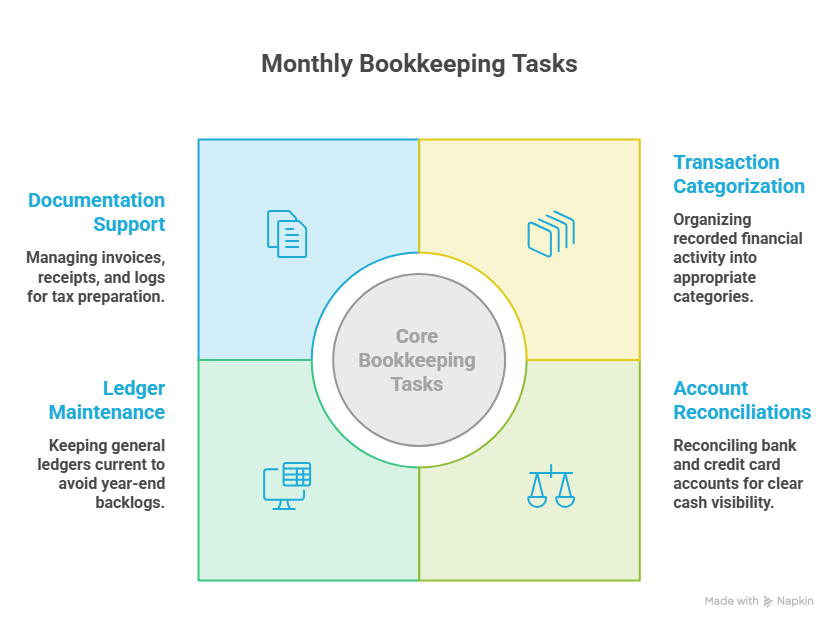
Monthly bookkeeping services commonly include transaction categorization, bank and credit card reconciliations, and general ledger maintenance. These procedures help organize recorded financial activity and identify items that may require clarification or adjustment.
Utilizing dedicated Houston bookkeeping services allows business owners to keep their general ledgers current rather than facing a large backlog at the end of the year. In many cases, timely monthly reconciliations support clear visibility into cash positions across multiple checking, savings, and credit accounts.
Organized accounting records can provide financial information used during tax preparation. Additional documentation, such as invoices, receipts, mileage logs, or other supporting records, may be required to substantiate particular deductions.
How Does Structured Financial Reporting Assist Management
Depending on the scope of the engagement, monthly accounting services may include recurring financial reports such as profit and loss statements and balance sheets. These reports provide information about recorded operating activity and financial position.
Partnering with professional Houston accounting services can support the generation of clear financial statements that reflect your operational performance. Depending on the business’s reporting needs and the scope of services, financial reports may include:
- Profit and loss statements showing revenue and expenses for a specified period.
- Balance sheets showing assets, liabilities, and equity at a specified date.
- Cash flow reports or statements of cash flows, when included in the engagement.
Reviewing these statements periodically can help owners understand their operational performance over time. This consistent documentation is often recommended for businesses seeking external financing or managing working capital across different quarters.
How Do Monthly Services Support Tax Filings and Compliance
Monthly accounting services can provide organized financial information for use in annual business tax preparation and other reporting activities. Regular transaction review and account reconciliation may also identify items requiring additional documentation or adjustment.
Integrating your monthly records with professional business tax preparation helps your preparer identify eligible business deductions and review applicable depreciation schedules.
IRS record-retention requirements vary depending on the type of record and the applicable tax rules. Many income tax records are generally retained for at least three years, although longer periods may apply. Records relating to property basis may need to be retained for longer periods, while employment tax records generally must be kept for at least four years.
For example, a growing distribution business might encounter multiple inventory purchases and freight adjustments across several quarters. If these transactions are categorized inconsistently throughout the year, the business owner may face complications when reconciling cost of goods sold during annual tax preparation.
When Might a Business Consider Fractional CFO Support?
Businesses may consider Fractional CFO in Houston or accounting advisory services when they need financial analysis beyond routine bookkeeping. Depending on the engagement, these services may involve budgeting, cash-flow forecasting, management reporting, or evaluation of significant financial decisions.
Fractional CFO and accounting advisory engagements may address matters such as capital expenditure planning, cash-flow management, financial projections, and accounting considerations related to business expansion.
From a tax perspective, regular strategic reviews can also provide clarity on how owner compensation and distributions align with federal guidelines. Having access to ongoing professional advice allows business owners to address financial questions as they arise.
How Do Software Tools and Professional Oversight Work Together
Accounting software can assist with importing, categorizing, and organizing transactions. Certain transactions, including equipment financing, shareholder loans, and other items requiring specialized accounting treatment, may warrant additional review and professional judgment.
Depending on their circumstances, Texas businesses may have state-level franchise tax reporting obligations, including applicable Public Information Reports or Ownership Information Reports. Employers may also have unemployment tax and reporting requirements administered by the Texas Workforce Commission.
Monthly Accounting Services FAQs
How do monthly accounting services differ from annual tax preparation?
Monthly accounting focuses on maintaining financial records and preparing periodic financial information. Tax preparation focuses on gathering and reviewing tax information, calculating applicable tax amounts, and preparing required returns. Although annual income tax returns generally report activity from a completed tax year, preparation activities may begin earlier.
Can artificial intelligence replace traditional bookkeeping professionals?
AI and accounting automation tools can assist with tasks such as transaction categorization, receipt processing, and data organization. Businesses should still establish procedures for reviewing financial records, reconciling accounts, and evaluating transactions that require additional accounting or tax judgment.
How long should a business keep its supporting financial documents?
Federal guidelines generally require businesses to keep income tax records for a minimum of three years from the filing date. Employment tax records must be retained for at least four years under IRS guidelines.
What Texas-specific filings are managed alongside monthly accounting?
Depending on the business’s structure and activities, Texas reporting obligations may include franchise tax filings and employer reporting through the Texas Workforce Commission. These filings may be coordinated with monthly accounting services when included within the scope of the engagement.
Steering Your Enterprise with Steady Financial Support
Establishing comprehensive monthly accounting services offers your business an organized foundation for ongoing reporting and operational reviews. By reviewing financial statements throughout the year, you can better anticipate tax obligations and maintain clear documentation for regulatory authorities.
Monthly accounting services can provide businesses with an organized process for recording transactions, reconciling accounts, and reviewing financial information throughout the year. Depending on the engagement, these services may be coordinated with tax preparation, payroll support, financial reporting, or Fractional CFO services. Dabney Tax & Accounting Services provides CPA-led bookkeeping and accounting services for businesses in Houston and throughout Texas.


