

Working with a CPA for back taxes can provide a structured way to address unfiled returns and overdue tax liabilities with federal authorities. Taxpayers receiving IRS notices may need assistance understanding outstanding balances, determining whether returns are missing, reviewing assessed penalties, and evaluating available payment or collection alternatives.
We recognize that facing past-due obligations can create administrative strain regarding your financial standing. Exploring how a certified professional assists with tax debt resolution allows you to evaluate appropriate relief options while meeting your ongoing legal responsibilities.
What Authority Does a CPA Hold Before Federal Agencies
Certified Public Accountants, enrolled agents, and attorneys generally have unlimited representation rights before the IRS. A CPA may represent taxpayers in matters involving outstanding balances, examinations, collections, and other federal tax issues when properly authorized. This credential allows a professional to represent clients on all tax matters regardless of who prepared the original return.
Taxpayers may authorize a qualified representative using IRS Form 2848, Power of Attorney and Declaration of Representative. The authorization identifies the applicable tax matters and periods and generally permits the representative to communicate with the IRS, obtain relevant tax information, and act on the taxpayer’s behalf within the authorized scope.
Having a qualified professional manage agency communications helps organize your case according to standard administrative procedures. This formal process allows taxpayers to address formal notices without needing to contact agency representatives directly.
How Does a Professional Assist With Past Due Tax Returns
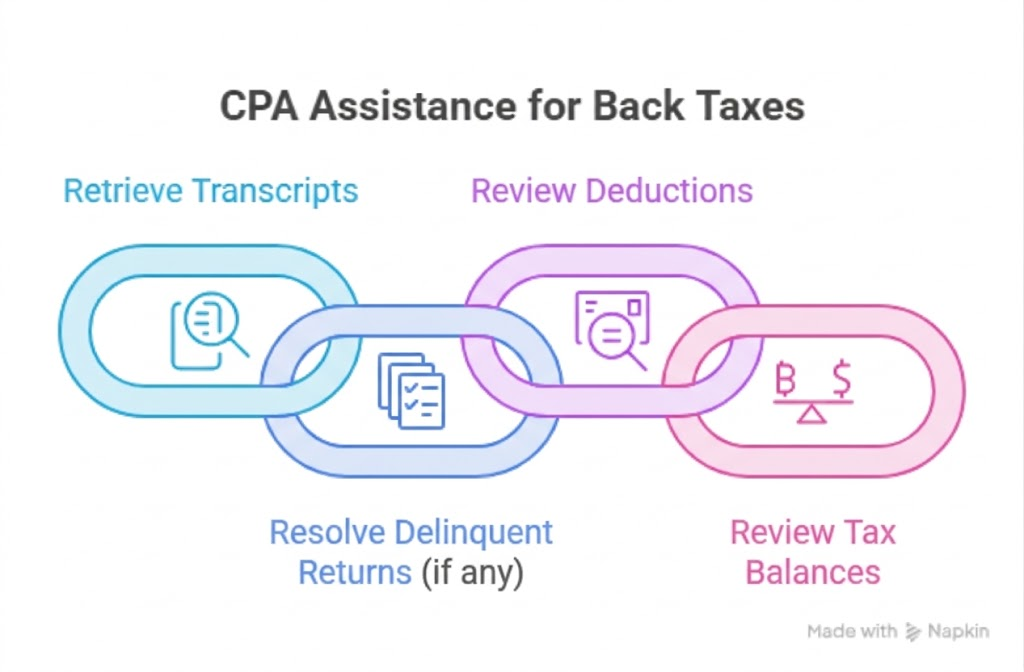
Assistance with delinquent tax returns may include obtaining available IRS transcripts, reviewing prior filings, organizing income and deduction records, and identifying missing information. Business taxpayers may also require bookkeeping cleanup or reconstruction of accounting records, depending on the circumstances and scope of the engagement.
Engaging professional personal tax preparation in Houston may allow individuals with unfiled returns to compile source documentation such as Form W2, Form 1099, and mortgage interest statements. In many cases, reviewing transcript data may help identify income reported by third parties that must be included on delinquent filings.
Preparing delinquent returns may involve reviewing available documentation to identify deductions and credits potentially applicable under the tax laws for the years involved. The treatment of individual items depends on the taxpayer’s circumstances and supporting records.
What Options Exist for Addressing Federal Tax Balances
Depending on their circumstances, taxpayers may be eligible for IRS collection alternatives such as installment agreements, Currently Not Collectible status, or an Offer in Compromise. These alternatives have different eligibility requirements and consequences. For example, Currently Not Collectible status generally suspends active collection efforts but does not eliminate the tax liability.
A CPA for back taxes can analyze your monthly living expenses and asset equity against IRS financial standards to identify realistic payment proposals. Qualifying taxpayers may explore several formal relief avenues based on their circumstances.
- Installment agreements, including streamlined arrangements when the taxpayer meets applicable IRS eligibility requirements.
- Partial payment installment agreements based on documented disposable income.
- Currently Not Collectible status for taxpayers experiencing financial hardship.
- An Offer in Compromise, which may permit eligible taxpayers to settle qualifying tax liabilities for less than the full amount owed when the IRS accepts the offer under applicable rules.
Evaluating these programs with professional support helps you present structured financial statements to the agency. Utilizing experienced IRS tax resolution in Houston can assist you in preparing the necessary collection information statements for federal review.
When Is Penalty Abatement an Option for Taxpayers
Certain IRS penalties may qualify for relief based on reasonable cause or applicable administrative waiver provisions, including First Time Abate. Eligibility depends on the type of penalty, the taxpayer’s compliance history, and the circumstances surrounding the failure.
For example, a self-employed taxpayer with multiple delinquent returns may need to review assessed penalties separately for each tax period. The availability of First Time Abate depends on applicable administrative requirements, while reasonable-cause relief requires evaluating the facts and circumstances surrounding the failure.
Consulting a CPA for back taxes can help clarify whether your filing history qualifies for penalty relief under IRS guidelines. Presenting well-documented written requests can support your petition to remove assessed administrative penalties.
How Do Business Owners Address Payroll and State Tax Debts
Business owners address employment and state tax debts by reconciling payroll ledgers and submitting delinquent reports to both federal authorities and Texas agencies. Unpaid federal payroll taxes can create significant collection issues.
Federal income tax withheld from employees and the employee portion of Social Security and Medicare taxes are generally considered trust fund taxes. Under applicable rules, certain responsible individuals may face personal liability through the Trust Fund Recovery Penalty.
Coordinating your delinquent filings with professional business tax preparation helps verify that business expenses and owner distributions are categorized consistently. Texas businesses may also need to address outstanding franchise tax reports or balances with the Texas Comptroller of Public Accounts. Employers with unpaid state unemployment taxes or delinquent wage reports may have separate matters involving the Texas Workforce Commission.
Managing multi-agency tax issues requires an organized approach to documentation and filing schedules. Several specific business items often require review during this process.
- Reconciling Form 941 employer quarterly tax returns.
- Addressing federal trust fund tax assessments.
- Reviewing applicable Texas franchise tax filings, including required Public Information Reports or Ownership Information Reports.
- Resolving state unemployment tax reporting with the Texas Workforce Commission.
Retaining a CPA for back taxes helps business owners navigate both federal tax obligations and Texas-specific compliance requirements. This comprehensive approach supports steady progress toward resolving multi-year business tax complications.
What Documentation Should You Gather Before Scheduling a Review
Before your appointment with a tax professional, organize recent notices from tax agencies, previous tax returns, and relevant bank statements. Compiling these financial records in advance allows your accountant to assess the current status of your tax account more efficiently.
IRS notices, account transcripts, prior tax returns, and other relevant records can help identify outstanding assessments, filing requirements, payment history, and collection activity. Determining applicable collection statute expiration dates may require additional transcript analysis and review of events that affect the collection period.
Working with a CPA for back taxes allows you to review your transcripts alongside your actual financial records. This organized preparation helps establish a clear roadmap for addressing unfiled returns and managing agency communication.
CPA for Back Taxes FAQs
Can a Certified Public Accountant assist with unresolved state tax liabilities?
A Certified Public Accountant can assist with state tax liabilities by preparing delinquent state returns and communicating with state revenue departments. In Texas, this includes addressing franchise tax reports and Texas Workforce Commission unemployment accounts.
What occurs if a taxpayer cannot afford to pay an outstanding tax balance?
Taxpayers unable to pay their full balance may be eligible for an installment agreement, Currently Not Collectible status, or other collection alternatives. The IRS evaluates eligibility based on the applicable program requirements and the taxpayer’s financial circumstances, which may include income, allowable expenses, assets, and equity.
How does IRS first-time abatement penalty relief work?
First-time abatement is an IRS administrative penalty-relief provision available for certain penalties when the taxpayer meets applicable compliance-history and other eligibility requirements. The IRS generally reviews the preceding three tax years and considers whether required returns have been filed and applicable payment requirements have been addressed.
Can past-due federal tax debt be completely forgiven by authorities?
An Offer in Compromise may allow eligible taxpayers to settle certain federal tax liabilities for less than the full amount owed. The IRS evaluates offers under applicable criteria, which may include the taxpayer’s ability to pay, asset equity, future income, liability disputes, or effective tax administration considerations. Acceptance is not guaranteed.
Evaluating Options for Outstanding Tax Liabilities
Addressing outstanding tax liabilities may involve reviewing IRS account information, preparing delinquent returns, evaluating penalties, and determining whether payment or collection alternatives are available.
The appropriate approach depends on the taxpayer’s filing history, financial circumstances, and the applicable tax rules. Dabney Tax & Accounting Services provides CPA-led tax preparation and IRS representation services for individuals and businesses dealing with outstanding federal tax matters. The scope of assistance is determined by the circumstances and terms of the engagement.


