

Comparing a bookkeeper vs. an accountant vs. a CPA is an essential first step when evaluating the financial management needs of your organization. Many business owners begin by managing their own transactions but eventually require specialized professional support as their operations expand.
Bookkeepers, accountants, and Certified Public Accountants may perform overlapping accounting responsibilities, but their qualifications, licensing requirements, and authorized professional services can differ. Understanding these distinctions can help businesses evaluate the type of support appropriate for their needs.
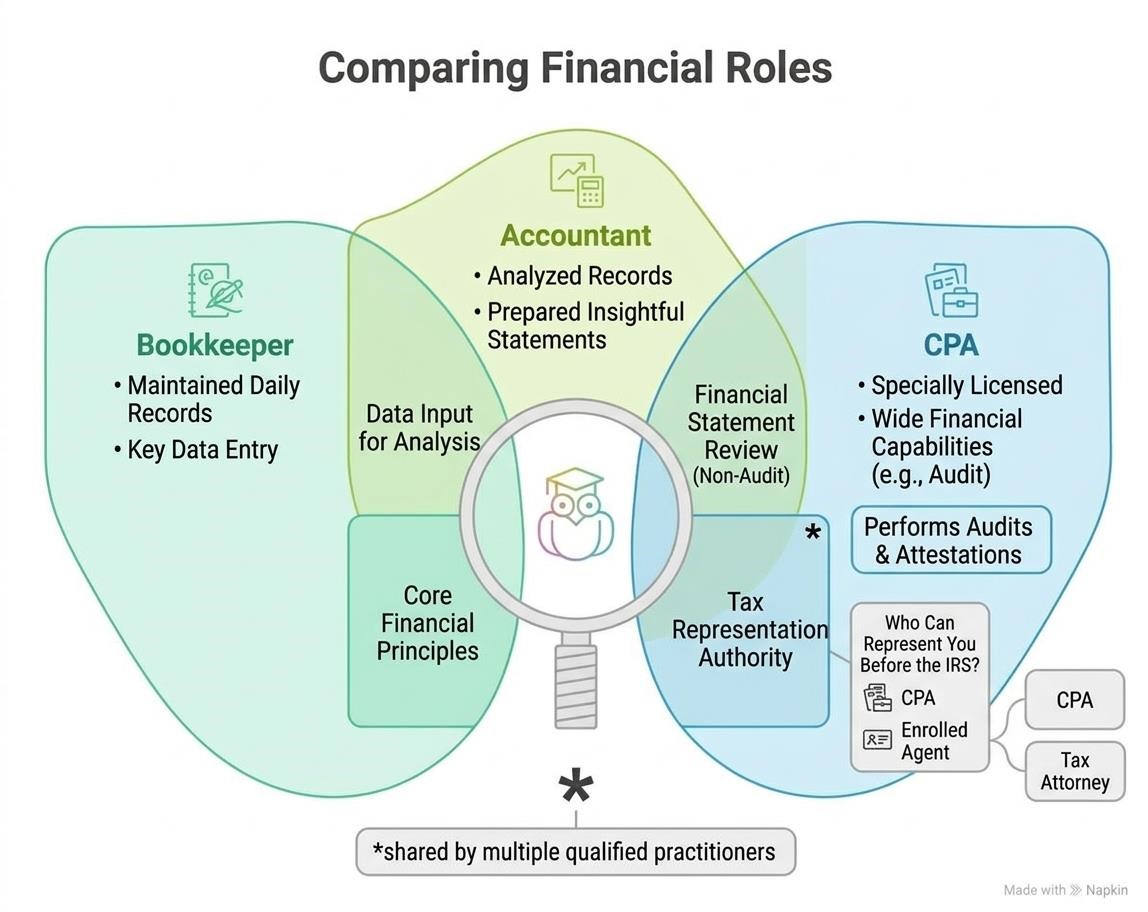
What Everyday Functions Fall to a Bookkeeper
Bookkeepers generally focus on maintaining financial records, including recording transactions, categorizing income and expenses, reconciling accounts, and organizing supporting documentation. Responsibilities vary depending on the professional’s experience and the scope of the engagement.
Utilizing dedicated Houston bookkeeping services allows business owners to keep their daily records organized throughout the year. In many cases, consistent ledger updates support clearer visibility into cash positions and operating expenses.
Bookkeepers typically do not require formal college degrees or state licenses to perform routine recording functions. Their work establishes the foundational data that other financial professionals review and analyze later.
Several core responsibilities are commonly managed by these professionals:
- Recording daily customer payments and sales receipts.
- Matching vendor bills against operational purchase orders.
- Performing monthly reconciliations across checking and credit accounts.
- Tracking baseline payroll data and employee hours.
How Does an Accountant Expand on Financial Data
Accountants may analyze financial records, prepare internal financial reports, review accounting classifications, assist with budgeting, and provide tax preparation or other accounting services based on their qualifications and engagement scope.
Partnering with professional Houston accounting services can support management in reviewing periodic performance reports and balance sheets. Many accountants have formal education in accounting or a related field, although educational backgrounds and professional qualifications vary. Unlike the CPA designation, the general occupational title ‘accountant’ does not necessarily indicate an active professional license.
When evaluating a bookkeeper vs. an accountant vs. a CPA, you will find that accountants often assist with budgeting, forecasting, and routine tax filings. They review the general ledger to determine whether transactions align with standard accounting frameworks.
Reviewing internal financial reports can provide management with information about operating expenses, revenue trends, and financial position.
What Sets a Licensed CPA Apart from Other Professionals
A Certified Public Accountant is a state-licensed accounting professional who meets applicable education, examination, experience, and continuing education requirements. CPAs generally have unlimited representation rights before the IRS and may provide tax, accounting, and advisory services. Certain financial statement assurance engagements are subject to additional professional and regulatory requirements and are not offered by every CPA firm.
CPA licensing requirements are established by state boards of accountancy and generally include qualifying education, successful completion of the Uniform CPA Examination, relevant professional experience, and other applicable requirements. Texas provides multiple pathways to CPA licensure, with specific education and experience requirements depending on the pathway.
This advanced credential provides significant legal standing when navigating complex tax inquiries or agency examinations. In the discussion of a bookkeeper vs. an accountant vs. a CPA, CPAs, enrolled agents, and attorneys generally have unlimited representation rights before the IRS.
A CPA may represent taxpayers in federal tax matters when properly authorized, while representation before state tax agencies depends on the applicable state’s rules and requirements
Maintaining this level of licensure requires adherence to a strict professional code of conduct. CPA licensure also involves professional conduct and continuing education requirements established by the applicable state licensing authority.
How Do Education and Licensing Compare Across Roles
Education and regulatory licensing requirements represent the clearest structural difference between these three financial paths. Bookkeepers generally enter the field through practical clerical experience or specialized software certificates without statutory degree mandates.
Accountants typically earn an undergraduate or graduate degree in accounting, which prepares them for advanced financial analysis and reporting. In contrast, CPAs must satisfy state board education criteria, pass the Uniform CPA Examination, and complete verified work experience under a licensed professional.
When comparing a bookkeeper vs. an accountant vs. a CPA, these credential tiers correspond directly to the scope of services each professional can legally provide. CPA licensure establishes professional qualifications and regulatory responsibilities that differ from those associated with unlicensed bookkeeping and accounting roles.
However, other qualified tax professionals, including enrolled agents and attorneys, may also provide tax services and represent taxpayers before the IRS.
Several distinct milestones define the progression across these professional levels.
- Bookkeepers may develop qualifications through experience, training, and accounting software certifications.
- Accountants may have formal accounting education, professional experience, or specialized training.
- CPAs must satisfy applicable state education, examination, experience, and licensing requirements.
- Licensed CPAs must satisfy applicable continuing professional education and professional conduct requirements.
When Does Your Organization Need Each Service Tier
Businesses may use bookkeeping support for transaction recording and reconciliations, accounting services for financial reporting and analysis, and qualified tax professionals for tax preparation, planning, or representation. Depending on the provider’s qualifications and engagement scope, several of these services may be coordinated through one firm.
For example, a growing distribution business might employ an internal bookkeeper to record daily inventory purchases and customer receipts. As the enterprise expands into neighboring states, the leadership might encounter complex state franchise tax questions and interstate payroll considerations that require review by a licensed CPA.
Analyzing the spectrum of a bookkeeper vs. an accountant vs. a CPA helps you determine when administrative data entry is sufficient and when credentialed oversight is needed. Coordinating your reporting with professional tax preparation services in Houston can help you transition between these operational tiers as your needs evolve.
Working with the appropriate specialist at each stage helps maintain organized records. This structured approach allows your administrative workflows to keep pace with your commercial growth.
How Do Texas State Regulations Apply to Financial Roles
Texas state regulations establish clear boundaries regarding who may practice public accountancy and use specific professional titles. The Texas State Board of Public Accountancy governs CPA licensing to protect the public interest across the state.
While bookkeepers and accountants can perform general recording and management support in Texas, they cannot hold themselves out as licensed CPAs without meeting board standards.
Furthermore, Certain Texas businesses have franchise tax reporting obligations, while employers may also have unemployment tax and wage-reporting requirements administered by the Texas Workforce Commission. The applicable obligations depend on the entity and its operations. Several regulatory factors influence how these roles operate in Texas:
- State Board governance of public accountancy licensure.
- Unlimited IRS representation rights generally available to CPAs, enrolled agents, and attorneys.
- Specific Texas franchise tax reporting rules for registered entities.
- Quarterly payroll reporting requirements under the Texas Workforce Commission.
Bookkeeper vs Accountant vs CPA FAQs
What can a CPA do that a bookkeeper cannot?
A CPA is a state-licensed professional who may provide tax preparation, tax planning, accounting advisory, and IRS representation services. CPAs generally have unlimited IRS representation rights, as do enrolled agents and attorneys. Certain assurance engagements require additional professional qualifications and firm-level requirements. Dabney Tax & Accounting Services does not provide financial statement audits, reviews, or compilations.
Can a CPA also perform daily bookkeeping work?
Yes. CPAs may perform bookkeeping services, and CPA-led firms may offer bookkeeping alongside tax preparation, tax planning, and accounting advisory services. The specific services included depend on the engagement.
Do bookkeepers require a license to work in Texas?
Bookkeepers do not require a state license to perform standard bookkeeping and recording tasks in Texas. State licensing is specifically required for individuals who practice public accountancy and hold the CPA designation.
How do you choose between an accountant and a CPA for annual filings?
Choosing between an accountant and a CPA often depends on the complexity of your profile and whether you anticipate needing representation before tax authorities. CPAs offer credentialed oversight and unlimited representation rights for complex tax situations.
Choosing the Appropriate Accounting and Tax Support
Understanding the differences among bookkeepers, accountants, and CPAs can help business owners evaluate the professional services appropriate for their accounting and tax needs.
Qualifications, experience, and engagement scope should be considered alongside the services required. Dabney Tax and Accounting Services provides CPA-led bookkeeping, accounting, tax preparation, tax planning, and advisory services for businesses in Houston and throughout Texas.


