

“Are medical expenses tax-deductible?” is a question we often hear from individuals and families across Houston, Katy, Sugar Land, and The Woodlands during tax season, especially when out-of-pocket healthcare costs have been higher than usual.
In our experience, Houston area communities are not just asking if the cost was medical. They are also trying to understand whether the expense counts for tax purposes and whether the total amount is high enough to matter on a return.
How the Medical Expense Deduction Generally Works
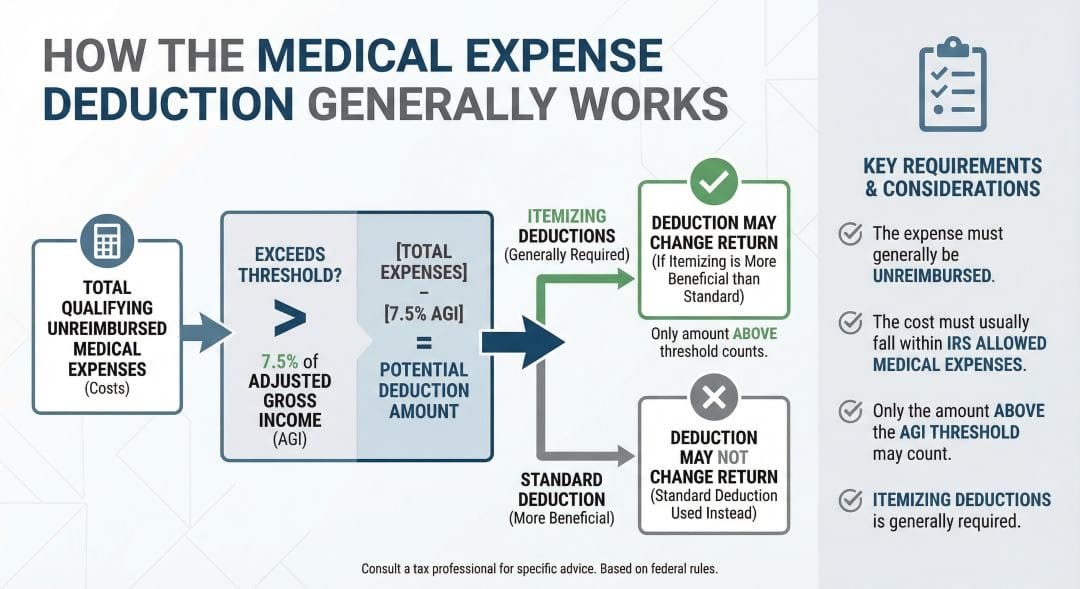
When we discuss this topic with taxpayers in Downtown Houston, West University, and Cypress, we usually begin with the basic federal rule. Medical expenses may be deductible only to the extent that qualifying unreimbursed costs exceed 7.5 percent of adjusted gross income, and itemizing is generally required.
That is why “Are medical expenses tax-deductible?” is not always a simple yes or no answer. A taxpayer may have valid medical expenses, but if the total does not exceed the threshold or if the standard deduction is more beneficial, the deduction may not change the return. A few general points usually shape the discussion:
- The expense must generally be unreimbursed
- The cost must usually fall within IRS allowed medical expenses
- Only the amount above the AGI threshold may count
- Itemizing deductions is generally required
For taxpayers gathering records before filing, individual tax preparation may support a more organized review of income, deductions, and documentation.
What Types of Medical Expenses May Qualify
In our work with families and individuals in The Heights, Montrose, and Clear Lake, we often find that people assume all health-related spending counts the same way for taxes. In practice, the rules are narrower.
When people ask “Are medical expenses tax-deductible?”, we generally explain that qualifying costs may include certain doctor visits, dental care, prescription medications, medical equipment, and some transportation related to medical care. In some cases, health insurance premiums paid with after-tax dollars may also be reviewed as part of medical expenses.
According to IRS Publication 502, medical expenses generally include diagnosis costs, cure, mitigation, treatment, or prevention of disease, along with certain treatments affecting the body. That resource can be useful for taxpayers in Houston and across Texas who want a high-level view of what the IRS generally includes.
Why the 7.5 Percent Threshold Matters
One of the most common reasons this deduction creates confusion is that taxpayers may have legitimate medical costs but still not receive a tax benefit from them. That is because the IRS threshold matters before any portion of the deduction may apply.
So when reviewing medical expenses, we usually encourage people to think about the total picture rather than one bill at a time. An adjusted gross income of $50,000 would generally need qualifying unreimbursed medical expenses above $3,750 before any excess amount could be considered as an itemized deduction.
This threshold often becomes more relevant in years involving surgery, extended treatment, specialist care, or high out-of-pocket premiums. For some self-employed taxpayers and business owners in Houston neighborhoods like Midtown and River Oaks, business tax preparation may also be part of the broader tax review when tax questions arise in the same year.
A Houston-Based Client Case Study
In one Houston area example, we worked with an individual in Pearland who had a year with several specialist visits, prescription costs, and travel for treatment. During the tax preparation process, the client asked whether those expenses could be claimed. As part of that review, we explained that whether medical expenses may be deductible depends on more than whether the costs were medically related.
We also needed to look at reimbursement, adjusted gross income, and whether itemizing made sense compared with the standard deduction. We share this as a general example of the type of question we often hear from Texas taxpayers.
Health Insurance Premiums and Related Questions
In general, premiums may be reviewed differently depending on how they were paid and whether they were already treated on a pre-tax basis.
That is another reason “Are medical expenses tax-deductible?” can be more complex than it first appears. If premiums were paid with after-tax dollars, they may be part of itemized medical expenses in some cases. If they were paid through an employer plan on a pre-tax basis, the tax treatment may be different. Self-employed taxpayers may also have separate rules that can apply depending on their circumstances.
For taxpayers who want to review these issues before the filing deadline gets closer, tax planning may support earlier organization and comparison.
Why Recordkeeping Still Matters
In our experience, taxpayers in Houston often have some qualifying expenses but incomplete records. That does not automatically mean the expenses will be claimed or excluded, but it may make the review more difficult.
When asking “Are medical expenses tax-deductible?”, documentation is often part of the bigger picture. Records such as invoices, receipts, insurance statements, and mileage logs may help support what was paid, whether reimbursement occurred, and when the expense was incurred.
This does not mean every taxpayer with medical costs will benefit from itemizing. In many cases, the standard deduction may still be more favorable. Still, maintaining clear records may make it easier to review the deduction properly when medical costs are unusually high in a given year.
FAQs
Is it worth claiming medical expenses on taxes?
In many cases, it may be worth reviewing medical expenses if qualifying unreimbursed costs were high and itemizing is being considered. Whether the deduction has an impact on the return depends on the full tax picture, including the 7.5 percent AGI threshold.
Can I deduct health insurance premiums?
Sometimes. Health insurance premiums may be reviewed differently depending on how they were paid. Premiums paid with after-tax dollars may be treated differently from premiums already handled on a pre-tax basis.
Do all doctor and pharmacy costs count as deductible medical expenses?
Not always. Some doctor visits, prescriptions, and medically necessary items may qualify, but the IRS rules are specific, and some personal health-related purchases may not count the same way for tax purposes.
Do I need to itemize to claim medical expenses?
In general, yes. The medical expense deduction is usually claimed as an itemized deduction, so taxpayers taking the standard deduction would generally not claim those expenses separately.
Key Takeaways
For taxpayers across Houston, “Are medical expenses tax-deductible?” is an important tax question, especially after a year with higher out-of-pocket healthcare costs. In general, some expenses may qualify, but the deduction depends on IRS rules, reimbursement status, the 7.5 percent AGI threshold, and whether itemizing makes sense.
In our experience, the issue is usually not whether a cost feels medical. At Dabney Tax & Accounting Services, our team works with Houston taxpayers to analyze how medical expenses may be treated based on each taxpayer’s financial situation.


