

“Can married couples file separately?” is one of the most common tax questions we hear from households across Houston, Katy, Sugar Land, and The Woodlands as filing season approaches. From a federal tax perspective, married couples who were legally married by December 31 are generally allowed to choose either married filing jointly or married filing separately.
In our experience, many couples in Pearland, Memorial, Bellaire, and other Houston area communities start with the assumption that joint filing is the only practical option. It is also a question about how each filing status may affect deductions, credits, and overall tax reporting. This article provides a general overview to explain how these rules may apply in general.
How Married Filing Status Usually Works
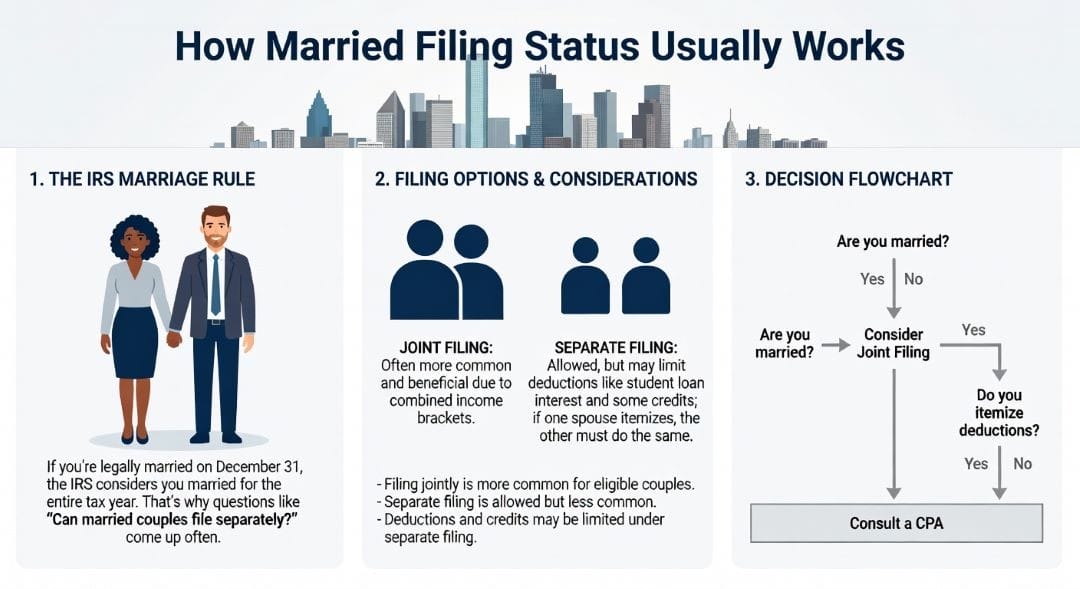
We often begin with the same general IRS rule when discussing filing status with couples in Downtown Houston, Cypress, and West University. If a couple is legally married on the last day of the year, the IRS generally considers them married for that full tax year.
That is why questions like “Can married couples file separately?” come up so often during return preparation. The answer is generally yes, but the more meaningful question is whether separate filing makes sense to compare for that household’s tax picture. A few basic points usually shape the conversation:
- Filing jointly is often more common
- Filing separately is generally allowed for eligible married couples
- Some deductions and credits may be limited under separate filing
- If one spouse itemizes, the other spouse may need to do the same
For readers trying to stay organized throughout the year, financial reporting and analysis may support clearer visibility into income and expenses before tax season begins.
Why Some Couples Compare Separate Filing
In our work with taxpayers around Midtown, River Oaks, and Pasadena, we have seen that filing separately is usually reviewed for practical reasons rather than as a default choice. This is one reason topics like “Can married couples file separately?” are common.
From a general tax perspective, couples may compare separate filing when one spouse has higher medical expenses, when incomes differ significantly, or when one spouse wants to understand their filing position separately from the other. In some situations, student loan repayment calculations or liability considerations may also be part of the discussion.
What May Change When Filing Separately
When we walk clients through this comparison in places like The Heights, Montrose, and Clear Lake, we usually explain that a separate filing may affect more than just the tax rate. For many couples, the real issue is how deductions and credits are treated.
According to the IRS, if one spouse itemizes deductions, the other spouse generally must also itemize. That rule can matter for couples across Houston and nearby Texas communities who are trying to compare separate returns fairly.
A Houston Area Example from Client Work
In one Houston area engagement, we worked with a married couple in Katy who wanted to compare joint filing with separate filing for the year. One spouse had W-2 income, while the other had self-employment income and higher out-of-pocket medical expenses.
As we reviewed the general tax picture with them, we explained that whether married couples file separately is a valid question, but the comparison often depends on more than one issue. The household needed to look at deductions, credit limitations, and how each filing status affected the return as a whole.
We share this as a general example of the kinds of questions Texas couples may bring into a filing status review. It is illustrative only, and tax outcomes vary based on each household’s records, income, and reporting details.
In addition, for business owners and self-employed taxpayers in areas like Katy and Sugar Land, business tax preparation may also be part of the larger tax picture when business income flows into a personal return.
Why This Comparison Matters for Texas Households
Although Texas does not impose a state income tax, federal filing status still matters for couples in Memorial, Pearland, Conroe, and Baytown. In our experience, many households ask about separate filing because they want to better understand how tax responsibility is handled on each return or because one spouse’s financial picture is materially different from the other’s.
That is another reason “Can married couples file separately?” remains a relevant search topic year after year. Some taxpayers are comparing total tax due, while others are focused on documentation, expenses, or the effect of income-based obligations. A general review may include:
- Comparing the total tax under each filing status
- Looking at possible deduction limitations
- Reviewing whether itemizing affects both spouses
- Considering how income differences change the overall picture
For households that prefer to compare options earlier in the year, tax planning may support a more organized review before the filing deadline gets closer.
How We Generally Frame the Decision
When couples in Uptown, Bellaire, and The Woodlands ask us this question, we usually frame it as a comparison rather than a rule-based decision. Joint filing may offer access to tax benefits that are not available under separate filing. At the same time, a separate filing may still be worth reviewing in certain circumstances.
For that reason, whether married couples file separately is best understood as the starting point, not the final answer. A practical review often looks at income, deductions, credit eligibility, and whether one spouse’s financial situation makes separate filing worth modeling out.
FAQs
What is the special rule for married filing separately?
A commonly referenced guideline is that when one spouse itemizes deductions, the other is typically required to do the same. Filing separately can also restrict eligibility for certain credits and deductions, depending on the specific tax year and the household’s circumstances.
How can couples compare married filing jointly with married filing separately?
We generally look at both filing statuses side by side and compare income, deductions, credit eligibility, and any limitations that may apply. In many cases, that provides a clearer view than relying on assumptions.
Can married couples file separately if they lived together all year?
In general, yes. If they were legally married at year’s end, they may still be eligible to use the married filing separately status for federal tax purposes, even if they lived together during the year.
Is filing separately always better when one spouse has large medical expenses?
Not always. Some couples review separate filing because certain thresholds may work differently, but the overall result depends on the full tax picture, including any credits or deductions that may change.
The Bottom Line
For married taxpayers across Houston, “Can married couples file separately?” is a valid tax question and an important filing status comparison. The IRS generally allows that option for couples who were married by year’s end, but whether it is worth using depends on the broader details of the return.
At Dabney Tax & Accounting Services, our team works with Houston couples to analyze filing status options as part of comprehensive tax preparation and planning services. Whether couples need help comparing filing scenarios or planning for the most appropriate filing approach based on their situation, professional guidance may help provide clarity when comparing filing options that affect household finances.


