

Understanding Texas capital gains tax and state laws is important for investors and property owners evaluating the tax consequences of selling an asset at a gain. While selling an asset at a gain is a positive financial event, the resulting tax obligations can be confusing without the right information.
At Dabney Tax & Accounting Services, our CPA-led tax services can help clients understand federal reporting requirements and how Texas’s lack of an individual income tax affects their overall tax picture. Year-round tax planning can also provide an opportunity to consider the potential tax consequences of significant transactions before year-end.
Texas Does Not Impose an Individual Capital Gains Tax
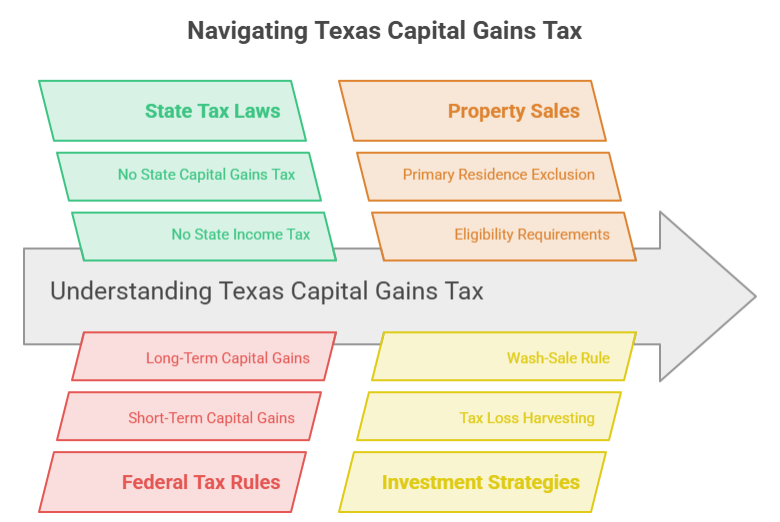
One of the most significant benefits of living in the Lone Star State is that there is no state-level Texas capital gains tax. This means individuals pay zero percent to the state on profits from selling investments like stocks, bonds, real estate, or businesses.
Texas does not impose an individual income tax, so individuals generally do not pay Texas state income tax on capital gains. The Texas Constitution also prohibits the legislature from imposing a tax on the net incomes of individuals, including an individual’s share of partnership and unincorporated association income.
Additionally, the state does not collect an inheritance or estate tax, which allows families to pass on assets with fewer state-level complications.
How Federal Rules Apply to Local Investors
Although Texas does not impose an individual capital gains tax, federal tax rules generally apply when taxpayers sell or otherwise dispose of capital assets. The IRS taxes these profits based on how long you owned the asset before selling it.
A capital asset generally produces a short-term capital gain or loss when held for one year or less and a long-term capital gain or loss when held for more than one year. Net short-term capital gains are generally taxed at ordinary income tax rates, while net long-term capital gains may qualify for preferential federal tax rates depending on the taxpayer’s circumstances.
According to the IRS Schedule D instructions, capital transactions must be reported with precise detail regarding holding periods and cost basis to remain compliant with federal tax laws.
The Primary Residence Exclusion and Property Sales
Home sellers in the Houston area may qualify for a federal home sale tax benefit when disposing of a primary residence. Meeting the requirement of having owned and used the property as your main home for at least two of the five years before the sale may allow you to exclude part of the resulting gain from federal taxable income.
Eligible taxpayers may exclude up to $250,000 of qualifying gain from the sale of a main home, while married couples filing jointly may qualify for an exclusion of up to $500,000 when the applicable requirements are satisfied. Applying the exclusion rules properly can reduce the taxable gain and help homeowners retain more of the proceeds from a property sale.
For example, a homeowner who sells a main residence should review the property’s adjusted basis, ownership and use periods, prior use of the home-sale exclusion, and other applicable requirements before determining how much of the gain, if any, must be reported as taxable income.
Working with a professional for individual tax preparation guidance can help manage your personal filings and Texas capital gains tax documentation with consistency.
Tax Loss Harvesting and Strategic Planning
Selling an investment at a loss can create a tax benefit when the loss is used to reduce gains from other investments. If the losses recorded during the year are greater than the total capital gains, taxpayers may generally claim as much as $3,000 of the unused amount against ordinary income, provided they meet the applicable tax requirements.
Investors should also consider the wash-sale rules, which can disallow a loss when substantially identical stock or securities are acquired within the applicable 61-day window beginning 30 days before and ending 30 days after the loss sale. The disallowed loss is generally added to the basis of the replacement securities when applicable.
Considering the tax consequences of investment transactions as part of year-round tax planning can help taxpayers understand how realized gains and losses may affect their federal tax position.
Real Estate Exchanges and Business Profits
A properly structured Section 1031 like-kind exchange may allow a taxpayer to defer recognition of gain when qualifying real property held for investment or productive use in a trade or business is exchanged for qualifying like-kind real property. Deferred exchanges are subject to specific requirements and generally require careful structuring to avoid actual or constructive receipt of the proceeds.
For a typical deferred exchange, replacement property generally must be identified within 45 days after the relinquished property is transferred and received by the earlier of 180 days after the transfer or the due date, including extensions, of the applicable tax return.
Understanding the tax treatment of these transactions can provide useful information when evaluating their effect on the business’s financial and tax position. Coordinating significant asset transactions with business tax preparation guidance can also help ensure that applicable basis, gain, depreciation recapture, and reporting requirements are considered.
FAQs
When you sell a house in Texas, do you pay capital gains tax?
You do not pay any state-level capital gains tax because Texas has no personal income tax. However, you may still owe federal capital gains tax to the IRS depending on your profit level and whether you qualify for the primary residence exclusion.
What is the 6-year rule for capital gains tax?
The six-year rule is an Australian tax provision overseen by the Australian Taxation Office. It does not apply to United States or Texas capital gains tax filings, though the US has its own residency rules for property exclusions.
Are capital gains taxed differently by state?
Yes, they are taxed differently depending on where you live. While Texas has no state-level tax, many other states treat these profits as ordinary income and tax them at their standard state income tax rates.
How can the Net Investment Income Tax impact taxpayers living in Texas?
The Net Investment Income Tax is a 3.8% federal tax that may apply when a taxpayer has net investment income and modified adjusted gross income above the applicable federal threshold. The tax generally applies to the lesser of net investment income or the amount by which modified adjusted gross income exceeds the applicable threshold.
Strategic Support for Texas Investors
Managing capital transactions is most effective when you understand both the state advantages and the federal rules that apply to your portfolio. While Texas capital gains tax offers a highly favorable tax environment, federal filing requirements still demand careful documentation and planning.
If you are considering a significant investment, real estate, or business asset transaction, Dabney Tax & Accounting Services is available to help evaluate the related tax considerations. Seeking tax guidance before a transaction is finalized can provide additional time to understand applicable reporting requirements and available tax planning options.


