

S Corp taxes operate differently from most other business structures, and that difference is worth understanding before making any decisions about how a business is classified for tax purposes. For small business owners across Houston and Texas who are evaluating their options or already operating as an S Corporation, having a clear picture of how the tax rules work may help avoid costly surprises and support more informed planning conversations.
We work with business owners navigating S Corp filing requirements for the first time and those who have been operating as an S Corporation for years but want a clearer understanding of what the annual obligations actually involve. In our experience, the S Corp structure rewards business owners who stay organized, pay themselves appropriately, and maintain consistent records throughout the year.
What an S Corporation Actually Is
An S Corp is a tax election rather than a business entity. It is a status a business chooses by filing the appropriate form with the IRS rather than a structure created at the state level. Eligible domestic corporations and certain LLCs can elect S Corporation status if they meet IRS requirements, including having no more than 100 shareholders, only allowable shareholders, no nonresident alien shareholders, and only one class of stock.
The decision to elect S Corp status is primarily a tax decision. The legal entity remains in place at the state level while the S Corp election changes how the business is treated for federal tax purposes.
How Pass-Through Taxation Works
The most fundamental characteristic of S Corp taxes is pass-through taxation. An S Corporation generally does not pay federal income tax on its operating income at the business level. Instead, income, losses, deductions, and credits generally pass through to shareholders and are reported on their individual tax returns. Certain entity-level taxes can still apply in specific circumstances.
The business files an informational return each year but does not generally owe federal income tax itself. For Houston business owners currently operating as sole proprietors paying self-employment tax on all net business income, the pass-through structure of S Corp taxes can look meaningfully different once the reasonable salary requirement is factored in.
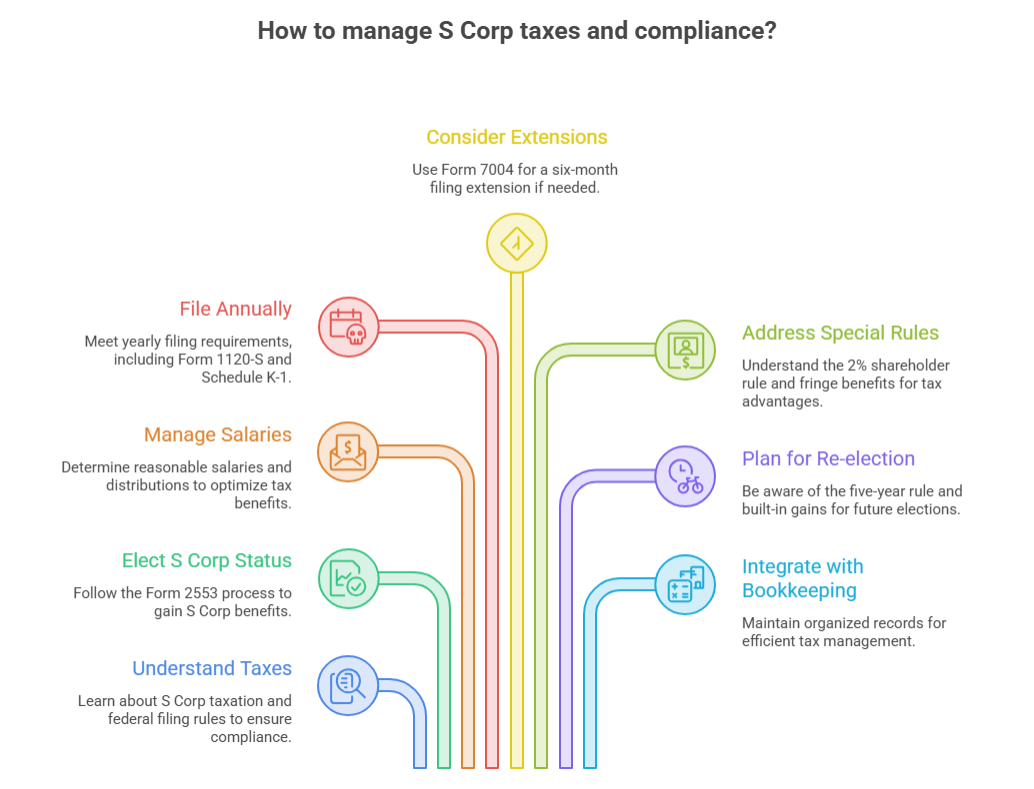
The Reasonable Salary Requirement
One of the most important elements of S Corp taxes is the requirement that owner-employees pay themselves a reasonable salary. When a shareholder performs services for the S Corporation as an employee, the corporation generally must pay reasonable compensation for those services before making non-wage distributions to the shareholder-employee.
Salary payments are subject to FICA taxes. Money taken as distributions beyond the salary is generally not subject to those employment taxes, which is one of the tax advantages the S Corp structure can offer.
The IRS does not define reasonable salary with a specific formula but generally expects it to reflect what the owner would pay someone else to perform the same role. Setting the salary too low relative to distributions may draw IRS scrutiny, which is one reason working with a CPA who understands S Corp taxes tends to be particularly valuable.
Consider an independent consultant who transitions an LLC from sole-proprietor taxation to S Corporation status as revenue grows. The owner would need to evaluate what level of W-2 compensation reasonably reflects the services performed before taking additional amounts as shareholder distributions.
Annual S Corp Filing Requirements
S Corp taxes come with specific annual federal filing obligations that business owners need to stay on top of each year.
Form 1120-S
The primary annual filing requirement is Form 1120-S, the S Corporation income tax return. This informational return reports the business’s income, expenses, deductions, and credits. For calendar-year businesses, Form 1120-S is generally due by March 15.
Schedule K-1
After filing Form 1120-S, the S Corporation must issue a Schedule K-1 to each shareholder showing their proportionate share of the business’s income, losses, deductions, and credits. Shareholders then use that information to complete their individual Form 1040 returns. Support through professional individual tax preparation guidance can help make that connection clearer and more organized for shareholders receiving K-1s for the first time.
Extensions
A six-month extension is available by filing Form 7004, moving the deadline from March 15 to September 15. The extension provides additional time to file Form 1120-S but does not extend the time to pay any tax that may be due at the entity level. Shareholders should also consider their individual estimated tax obligations related to pass-through income.
How to Elect S Corp Status
Electing S Corp status requires filing IRS Form 2553. For the election to take effect for the current tax year, Form 2553 generally needs to be filed by the 15th day of the third month of the tax year.
Connecting the election decision to a broader tax planning conversation tends to produce a more informed outcome than making the decision in isolation. The S Corp election can offer meaningful advantages in the right circumstances, but it also introduces ongoing compliance requirements that need consistent attention.
The 2% Shareholder Rule and Fringe Benefits
Shareholders who own more than 2% of an S Corporation are subject to special rules for certain fringe benefits. For example, qualifying health insurance premiums paid or reimbursed by the S Corporation generally must be included in the shareholder-employee’s Form W-2 income, although the premiums may qualify for the self-employed health insurance deduction on the shareholder’s individual return when applicable requirements are met.
Businesses that maintain consistent monthly records through bookkeeping services tend to have a considerably smoother experience with their annual S Corp filing.
The Five-Year Rule and Re-Election
If a business terminates its S Corp election, the IRS generally requires a five-year waiting period before re-electing. A separate five-year rule applies when a C Corporation converts to an S Corporation, during which certain built-in gains may still be subject to corporate-level tax if assets are sold within that window.
How S Corp Taxes Connect to Bookkeeping
The compliance requirements associated with S Corp taxes make consistent bookkeeping particularly important. Payroll records need to reflect the reasonable salary, shareholder distributions need to be tracked separately from compensation, and the annual Form 1120-S filing depends on books maintained throughout the year with sufficient detail.
According to the IRS S Corporation guidance page, S Corporations must meet ongoing compliance requirements including timely filing of Form 1120-S, proper issuance of Schedule K-1s, and adherence to shareholder eligibility rules to maintain their status.
FAQs
What is the five-year rule for S Corporations?
The five-year rule generally refers to two IRS provisions. The first is the re-election waiting period requiring a business that terminated S Corp status to wait five years before re-electing. The second applies when a C Corporation converts to an S Corporation, during which certain built-in gains may be subject to corporate-level tax if assets are sold within the five-year recognition period.
What is the 2% rule for S Corps?
Shareholders who own more than 2% of an S Corporation are subject to special tax rules for certain fringe benefits. For example, qualifying health insurance premiums generally must be included in the shareholder-employee’s Form W-2 income, while an eligible shareholder may be able to claim a corresponding self-employed health insurance deduction on the individual return.
Do S Corporations pay federal income tax?
Generally, S Corporations do not pay federal income tax on operating income at the entity level. Income, losses, deductions, and credits generally pass through to shareholders, although certain entity-level taxes, such as the built-in gains tax, may apply in specific circumstances.
What is a salary for an S Corp owner?
The IRS requires owner-employees to pay themselves a salary reflecting the fair market value of the work they perform, in line with what a similar role would command in the industry. The appropriate amount depends on the specific role, industry, and business financials.
S Corp Taxes Reward Owners Who Stay Organized Year-Round
S Corp taxes offer meaningful advantages for eligible business owners, but those advantages come with ongoing compliance requirements that need consistent attention. From the reasonable salary requirement to the annual Form 1120-S filing and proper issuance of Schedule K-1s, the structure rewards business owners who maintain organized records and work with a CPA who understands the specific obligations involved.
For business owners across Houston and Texas who want CPA-led support for their S Corp taxes and annual filing requirements, Dabney Tax & Accounting Services is available to help. Connecting before the March filing deadline rather than after it arrives is almost always the more manageable starting point.


