

The business tax filing deadline 2026 is not a single date but a series of dates that vary depending on how a business is structured, whether it has employees, and how income flows through to the owner. For business owners across Houston and Texas, missing any one of those dates can result in penalties and interest that add unnecessary cost to an already complex process.
We work with businesses of different sizes and structures who want to stay ahead of their filing obligations rather than scrambling when a deadline appears. In our experience, businesses that navigate tax season most smoothly treat the filing calendar as a year-round planning tool rather than a list of dates to react to.
Why Business Tax Deadlines Vary by Entity Type
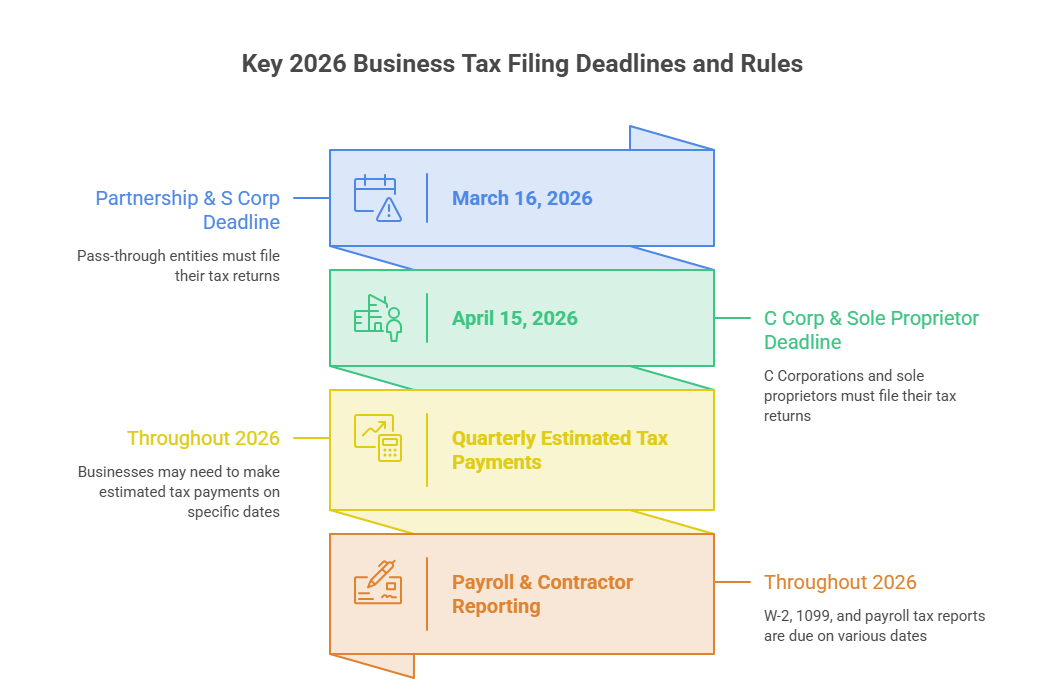
One of the first things worth understanding about the business tax filing deadline 2026 is that the date a business needs to file depends entirely on how it is classified for tax purposes. The general federal filing deadlines for the 2025 tax year, filed in 2026, are as follows:
- Partnerships filing Form 1065 and S Corporations filing Form 1120-S are due by March 16, 2026.
- C Corporations filing Form 1120 are due by April 15, 2026.
- Sole proprietorships and single-member LLCs filing Schedule C with Form 1040 are due by April 15, 2026.
When a deadline falls on a weekend or federal holiday, it generally shifts to the next business day. Business owners uncertain about which deadline applies to their specific structure may find it helpful to review their situation with a CPA before the first quarter of the year.
Pass-Through Entities and the March Deadline
Partnerships and S Corporations face an earlier business tax deadline for 2026 than many business owners expect. The March 16 deadline exists because these entities issue Schedule K-1 forms to their owners, who then need that information to complete their own individual returns by April 15.
A six-month extension is available by filing Form 7004, which moves the deadline to September 15, 2026. The extension applies to filing the return, not to paying any tax owed. An extension provides additional time to file the return but does not extend the time to pay any tax that may be due. Business owners should also consider whether pass-through income creates estimated tax obligations at the individual level.
C Corporation and Sole Proprietorship Deadlines
For C Corporations and sole proprietorships, the corporate tax deadline for 2026 aligns with April 15. C Corporations can request an automatic six-month extension using Form 7004, moving the filing deadline to October 15, 2026. Sole proprietors use Form 4868, which also extends the filing deadline to October 15, 2026.
As with all extensions, the payment deadline does not move with the filing deadline. We often find this distinction catches business owners off guard, particularly those filing for an extension for the first time.
Quarterly Estimated Tax Payment Dates
For business owners who expect to owe more than a certain threshold in taxes, quarterly estimated payments are generally required throughout the year. The quarterly estimated tax payment dates for 2026 are:
- January 15, 2026 for Q4 of the 2025 tax year
- April 15, 2026 for Q1 of the 2026 tax year
- June 15, 2026 for Q2 of the 2026 tax year
- September 15, 2026 for Q3 of the 2026 tax year
- January 15, 2027 for Q4 of the 2026 tax year
C corporations generally follow a separate estimated tax payment schedule, so corporate taxpayers should confirm the applicable payment dates based on their tax year and circumstances.
C corporations generally follow a separate estimated tax payment schedule, so corporate taxpayers should confirm the applicable payment dates based on their tax year and circumstances. Further, connecting those payment obligations to a broader tax planning conversation throughout the year may assist you in understanding the outcomes.
Payroll and Contractor Reporting Deadlines
Beyond the business return itself, the business tax filing deadline 2026 picture includes payroll and contractor reporting obligations that carry their own deadlines. Key dates include:
- February 2, 2026 for furnishing Forms W-2 to employees and filing them with the Social Security Administration, and for furnishing and filing Forms 1099-NEC for nonemployee compensation.
- Form 1099-MISC filing deadlines vary depending on the filing method and type of payment reported.
- April 30, July 31, November 2, 2026, and February 1, 2027 for quarterly Form 941 filings, reflecting weekend adjustments to the normal quarterly filing dates.
- Federal payroll tax deposit deadlines vary depending on whether the employer is a monthly or semiweekly schedule depositor.
- FUTA payments are due quarterly when liability reaches or exceeds $500.
Businesses that maintain consistent payroll records through payroll services tend to find these reporting deadlines considerably more manageable because the underlying records are already organized when the filing window arrives.
Commonly Overlooked Deadlines Worth Noting
Several deadlines within the business tax filing deadline 2026 calendar tend to be missed because they fall outside the periods most business owners are focused on. A few that come up regularly in our work include:
- the February 2 deadline for furnishing 1099-NEC forms, which is easy to miss when the new year is just beginning.
- the September 15 deadline for extended S Corporation and partnership returns.
- the October 15 deadline for extended C Corporation and sole proprietorship returns.
- the December 15 deadline for C Corporation fourth-quarter estimated payments.
Maintaining a filing calendar that includes all of these dates rather than only the primary April deadline is one of the more practical habits a business owner can develop.
New Tax Rules Worth Being Aware of for 2026
Several provisions of the One Big Beautiful Bill affect 2025 tax returns filed during the 2026 filing season and continue to affect tax planning for 2026. These include changes affecting the standard deduction, the SALT deduction limitation, and new deductions available to certain taxpayers.
One notable provision, effective for tax years 2025 through 2028, is an enhanced deduction of up to $6,000 per eligible individual age 65 or older by the end of the tax year and meet specific income requirements. Married couples meeting the eligibility criteria may qualify for up to $12,000.
According to the IRS, tax parameters are updated annually, and reviewing current figures with a CPA before filing tends to produce a more informed return.
How Organized Books Support Deadline Compliance
One theme that connects every deadline in the business tax filing deadline 2026 calendar is the importance of organized financial records. Whether the deadline involves a quarterly estimated payment, a payroll tax deposit, or the annual business return, the underlying financial data needs to be current for the filing to proceed without delays.
We often see businesses that are technically aware of their deadlines but arrive at each one without the records needed to file on time. Support through professional accounting services can help businesses maintain a view of their current financial position throughout the year, which in turn makes every deadline in the calendar more manageable.
FAQs
What are the new tax rules for filing in 2026?
For returns filed during the 2026 filing season, several provisions of the One Big Beautiful Bill affect 2025 tax returns, including new deductions for qualifying seniors, tips, and overtime. Additional provisions also affect tax planning for tax year 2026.
Who qualifies for the new $6,000 tax deduction in 2026?
The enhanced deduction provides up to $6,000 per eligible individual age 65 or older and is available for tax years 2025 through 2028. The deduction is subject to income-based phaseouts and other eligibility requirements. Married couples filing jointly may qualify for up to $12,000 if both spouses are eligible.
What is the business tax deadline for 2026 for S Corporations and partnerships?
For the 2025 tax year, S corporations and partnerships generally must file by March 16, 2026. Filing Form 7004 provides an automatic 6-month extension, moving the deadline to September 15, 2026.
What is the corporate tax deadline for 2026 for C Corporations?
C corporations generally must file Form 1120 by April 15, 2026. Form 7004 provides a six-month extension until October 15, 2026, but any taxes owed are still generally due by April 15.
Staying Ahead of the Calendar Makes Every Deadline More Manageable
The business tax filing deadline 2026 calendar involves more dates than most business owners initially expect, and the consequences of missing any one of them tend to be more costly than the effort required to stay on top of them. From quarterly estimated payments to payroll deposits to entity returns and extension deadlines, the full picture rewards consistent attention throughout the year.
For business owners across Houston and Texas who want CPA-led support for navigating the 2026 filing calendar, Dabney Tax & Accounting Services is available to help. Connecting early in the year rather than when a deadline is already approaching is almost always the more practical starting point.


