

Oil and gas outsourced accounting is often considered a practical approach for energy operators, royalty owners, and investors across Houston, Midland, Katy, and other parts of Texas who need specialized financial support without building a full internal accounting department.
The oil and gas industry operates differently from most other sectors. Joint interest billing, revenue distribution, division orders, regulatory compliance, and partnership accounting all create unique recordkeeping challenges. This article provides general educational information about how energy companies should review their accounting needs based on their own regulatory requirements.
Why the Oil and Gas Industry Demands Specialized Accounting
Energy accounting is not the same as general business accounting. A restaurant in Houston tracks sales and expenses. An oil and gas operator tracks wells, working interests, joint operating agreements, partner distributions, severance taxes, and capital expenditures across multiple properties and ownership structures.
For businesses that operate in the energy sector, understanding those differences is important because they matter. General bookkeepers may struggle with joint interest billing. Tax preparers without energy experience may not always account for industry-specific items such as intangible drilling costs or depletion. Financial reports that work for retail or service businesses may not reflect the realities of production, revenue splits, or partner obligations.
According to the Energy Information Administration, Texas remains the leading crude oil-producing state in the country, accounting for a significant portion of national output. That production activity supports a large network of operators, service companies, and financial professionals across the state, many of whom rely on specialized accounting support to manage complex operations.
What Oil and Gas Outsourced Accounting Typically Includes
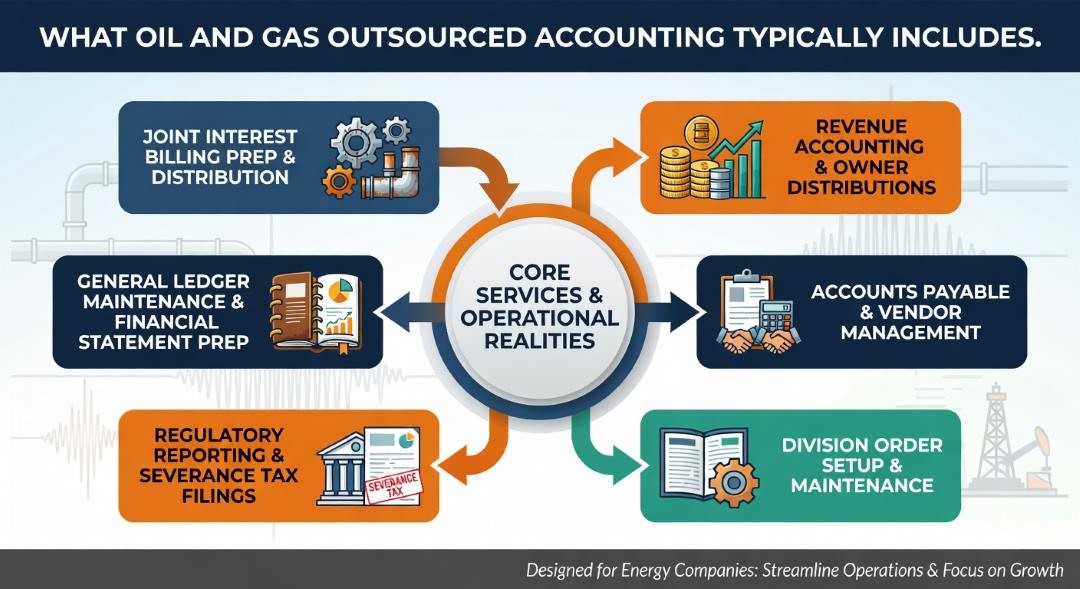
When energy companies review oil and gas outsourced accounting, they are usually looking at a set of core services that reflect the operational realities of the industry. These may include:
- Joint interest billing preparation and distribution
- Revenue accounting and owner distributions
- Accounts payable and vendor management
- Division order setup and maintenance
- Regulatory reporting and severance tax filings
- General ledger maintenance and financial statement preparation
For energy companies managing both operational accounting and individual owner tax obligations, individual tax preparation may also be relevant, especially when royalty income or working interest distributions flow through to personal returns.
How Outsourcing Supports Regulatory Compliance
Oil and gas companies face regulatory reporting requirements at both the state and federal levels. Texas operators must file severance tax returns with the Texas Comptroller, report production to the Texas Railroad Commission, and maintain compliance with lease and contractual obligations. Depending on where operations are located, additional state-level filings may apply.
Oil and gas outsourced accounting providers are typically familiar with those requirements and can help manage filings, deadlines, and documentation. That familiarity may help businesses stay organized around filing deadlines, incomplete filings, or errors that could lead to penalties or audit questions.
For business owners, financial reporting analysis may support better visibility when paired with industry-specific accounting processes.
A Texas Energy Example We Worked Through
A few years ago, an independent operator in the Permian Basin was managing a small portfolio of wells with multiple working interest partners. The operator had been handling accounting internally using spreadsheets and general bookkeeping software, but as the number of wells and partners increased, the process became harder to manage.
After choosing to work with us, specializing in oil and gas outsourced accounting, the operator began using software built for energy operations, a team familiar with JIB and division orders, and monthly financial reports that reflected production and partner activity consistently. The transition did not eliminate all challenges, but it did provide more structure and consistency to financial operations.
Why Scalability Matters in Energy Operations
Oil and gas activity can fluctuate significantly. Drilling programs ramp up during periods of high commodity prices and slow down when prices fall. Outsourcing may allow for scalable support. When a Texas operator in Katy or The Woodlands adds new wells or partners, the outsourced provider can adjust support levels to match the workload.
That flexibility is especially valuable for smaller independent operators and private equity-backed energy companies that need professional accounting support but cannot justify the cost of a full internal team during every phase of the business cycle.
For energy companies balancing operational accounting with tax planning around depletion, depreciation, and working interest income, tax planning may be part of a broader relationship that includes outsourced accounting and year-end tax preparation.
What Outsourcing Does Not Replace in Energy Operations
Oil and gas outsourced accounting handles execution, but it does not replace oversight. We often remind operators that you still need to approve AFEs, review partner agreements, monitor production, and make strategic decisions about drilling, development, and asset management. Outsourcing is about handling the financial details so leadership can focus more on operational decisions.
The relationship works best when communication is clear, and expectations are set from the start. Operators should expect clear communication around reporting, billing processes, and timelines. Outsourced providers should expect timely access to production data, vendor invoices, and partner agreements.
For energy companies in Conroe, Midland, or Sugar Land that want professional support without losing control, a collaborative approach can help keep the relationship productive and aligned with business goals.
FAQs
What services are typically included in oil and gas outsourced accounting?
Common services include joint interest billing, revenue accounting, division order processing, accounts payable and receivable, regulatory compliance support, and general ledger and financial statement preparation.
Why do energy companies choose to outsource accounting?
Energy companies often outsource to gain access to specialized industry expertise, reduce internal overhead, support reporting requirements, and scale support up or down based on operational activity.
What software platforms do oil and gas outsourced accounting providers typically use?
Many providers use industry-specific platforms such as WolfePak, OGSYS, Quorum, or PHDWin, which are designed to handle joint interest billing, revenue distribution, and energy accounting workflows.
Can outsourced accounting support regulatory compliance for Texas operators?
Yes, outsourced providers familiar with Texas energy operations can help manage severance tax filings, Railroad Commission reporting, and other state-level compliance requirements.
Final Considerations for Energy Companies
For oil and gas operators across Texas, from Houston and Katy to Midland and The Woodlands, the oil and gas outsourced accounting offers a way to manage complex financial operations without building a large internal team.
The energy industry is unique, and the accounting that supports it should reflect that reality. To support your business our team at Dabney Tax & Accounting Services provides accounting, bookkeeping, and tax support aligned with the needs of Texas energy companies.


