

Learning how to set up payroll is an important step when your business is ready to bring on its first employees. The process involves federal and state registrations, employee paperwork, and recurring tax filings that follow each pay period.
Texas business owners preparing to hire employees should understand the registrations, employee documentation, payroll calculations, and recurring filing requirements involved in establishing payroll.
What Is the First Step in How to Set Up Payroll
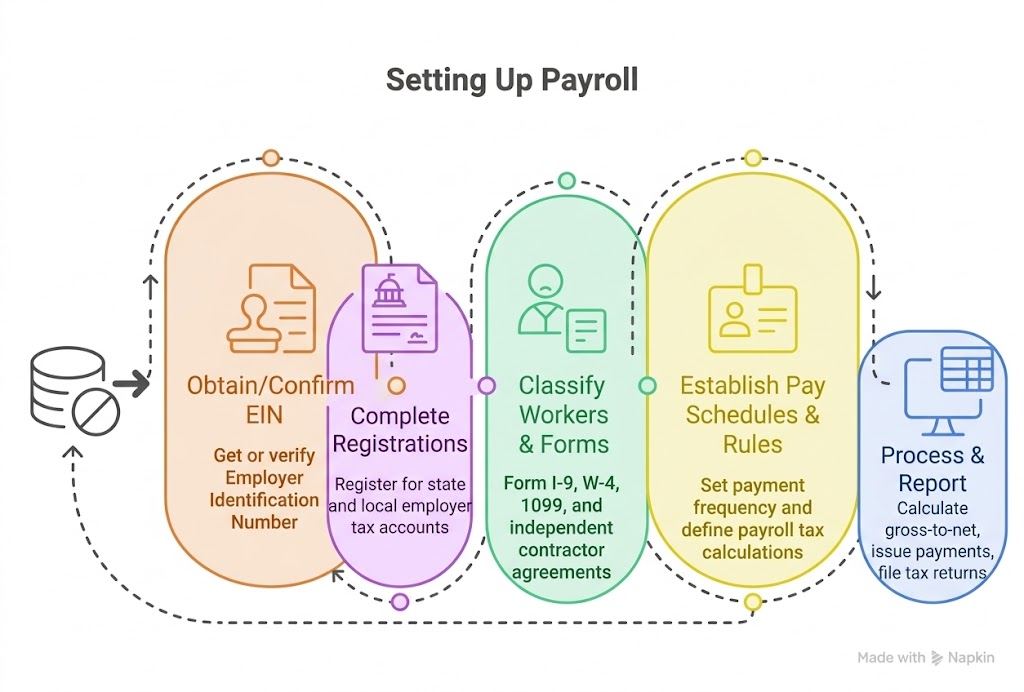
The first step in how to set up payroll is generally obtaining an Employer Identification Number from the IRS. This federal number identifies your business on employment tax returns, tax deposits, and the annual wage statements you provide to employees.
According to the official IRS guidance on Employer Identification Numbers, businesses can apply online, and the IRS does not charge a fee for this number. Many owners also choose to open a separate bank account for payroll, which can support clearer tracking of wages and tax deposits.
Which Texas Registrations Should New Employers Complete
Texas employers generally register with the Texas Workforce Commission for a state unemployment tax account once they meet the state’s liability criteria. Because Texas does not impose an individual income tax, there is no state income tax withholding to set up for employees.
New-hire reporting is a separate employer obligation. Texas employers generally must report newly hired and rehired employees to the Texas Employer New Hire Reporting program, administered through the Office of the Attorney General, within 20 calendar days of the employee’s hire or rehire date, subject to applicable reporting rules.
We find that keeping these agency roles distinct may help you track which filings belong to which agency. Each agency has its own reporting formats and deadlines, depending on the circumstances of your business.
How Should You Classify Workers Before Paying Them
You should determine whether each worker is an employee or an independent contractor before processing payments, since classification affects withholding and reporting. The IRS generally looks at factors such as behavioral control, financial control, and the overall relationship between the parties.
Employees are also classified as exempt or nonexempt for overtime purposes under the FLSA, which the Department of Labor administers. Classification depends on specific facts, so reviewing each role carefully is often recommended as an early part of how to set up payroll.
For example, a growing home services company might hire hourly technicians while also paying several helpers on a project basis. If the owner treats every worker the same way, the business may be unsure which workers require withholding and which should receive nonemployee compensation reporting instead.
What Information Should You Collect From Each New Hire
Employers should obtain a completed Form W-4 for federal income tax withholding and complete Form I-9 to verify employment eligibility. Form I-9 has separate employee and employer completion deadlines and generally must be retained by the employer rather than routinely submitted to USCIS.
Other details typically gathered during onboarding include the following:
- Full legal name, home address, and Social Security number.
- Start date, job title, and pay rate.
- Direct deposit authorization if you offer it.
- Benefit elections and any court-ordered deductions.
Having this information organized before the first pay date can make the remaining steps in how to set up payroll more manageable for you and your staff.
How Do You Choose a Pay Schedule That Fits Texas Rules
Texas employers may use weekly, biweekly, semimonthly, or monthly pay schedules when permitted by the Texas Payday Law. Employees who are not exempt from the FLSA overtime provisions generally must be paid at least twice per month, while employees who are exempt from those provisions generally must be paid at least once per month.
When deciding how to set up payroll, many owners choose a schedule that aligns with their existing cash flow cycles. Working with Houston payroll services can provide support with building a payroll calendar that coordinates pay dates with your tax deposit obligations.
How Do You Calculate Gross Pay and Withholdings
You calculate gross pay by multiplying hours worked by the hourly rate or dividing an annual salary by the number of pay periods. Under the FLSA, covered, nonexempt employees generally must receive overtime pay at no less than one and one-half times their regular rate of pay for hours worked over 40 in a workweek, subject to applicable exceptions and special rules.
From there, several amounts are typically withheld or calculated for each pay period:
- Payroll calculations generally involve both employee withholdings and employer tax obligations.
- Employee withholdings may include federal income tax, the employee’s share of Social Security and Medicare taxes, and applicable benefit or other authorized deductions.
- Employer payroll tax obligations generally include the employer’s share of Social Security and Medicare taxes, federal unemployment tax, and applicable Texas unemployment tax.
Net pay is the amount remaining after these withholdings and deductions. It is typically delivered by direct deposit or check along with a pay statement.
Which Deposits and Filings Follow Each Payroll
Employers generally deposit federal income tax withheld and both the employee and employer shares of Social Security and Medicare taxes electronically. The applicable monthly or semiweekly deposit schedule is generally determined using the IRS lookback- period rules. Special requirements may apply, including the $100,000 next-day deposit rule. Federal unemployment tax deposits follow separate requirements.
Common federal payroll filings include quarterly Form 941, annual Form 940 when applicable, and Forms W-2 and W-3 for annual wage reporting. Certain employers may file Form 944 or other employment tax returns depending on their circumstances and IRS requirements.
How Long Should You Keep Payroll Records
The IRS generally asks employers to keep employment tax records for at least four years, while the FLSA separately requires certain payroll records to be kept for at least three years. These are distinct federal requirements from different agencies, and recordkeeping remains an ongoing part of how to set up payroll.
Recording each payroll in your general ledger can support reconciliations between payroll reports, bank statements, and tax filings. Ongoing Houston bookkeeping services can provide help with categorizing wage expenses, employer taxes, and benefit deductions consistently each month.
What Should You Do if You Receive a Payroll Tax Notice
If you receive an IRS notice about payroll taxes, reviewing it promptly and comparing it with your filed returns and deposit records is generally recommended. Notices may relate to late deposits, mismatched filings, or questions about reported wages.
Certified Public Accountants generally have unlimited representation rights before the IRS and may represent taxpayers in employment tax matters, including IRS notices and payroll tax examinations. Dabney Tax & Accounting Services can provide IRS representation when included within the scope of the engagement.
How to Set Up Payroll FAQs
Can you run payroll by yourself as a small business owner?
Many small business owners choose to run payroll themselves, particularly when they have few employees and simple pay structures. Doing so generally involves tracking hours, calculating withholdings, making tax deposits, and filing required federal and state forms on time.
How can you teach yourself the basics of payroll?
Many owners start by reviewing IRS Publication 15, which outlines federal employment tax responsibilities, along with Department of Labor wage and hour resources. Hands-on practice with payroll software and periodic reviews of state agency guidance can also support your learning.
Do Texas employers withhold state income tax from paychecks?
Texas does not impose an individual income tax, so there is no state income tax to withhold from employee wages. Employers still handle federal withholding, Social Security and Medicare taxes, and state unemployment tax through the Texas Workforce Commission.
Do you need a separate bank account for payroll?
A separate payroll account is not generally required by federal law, but many businesses choose one to keep wage payments and tax deposits apart from operating expenses. This separation can support clearer reconciliations and recordkeeping.
Building a Payroll Foundation That Grows With Your Team
Knowing how to set up payroll step by step gives you a clearer starting point for registrations, employee paperwork, and recurring filings. Every business has different pay structures and obligations, so reviewing your specific situation with a qualified professional is often recommended.
If you would like support as you prepare to pay your first employees, you can connect with Dabney Tax & Accounting Services to discuss your payroll setup and ongoing compliance needs.


