

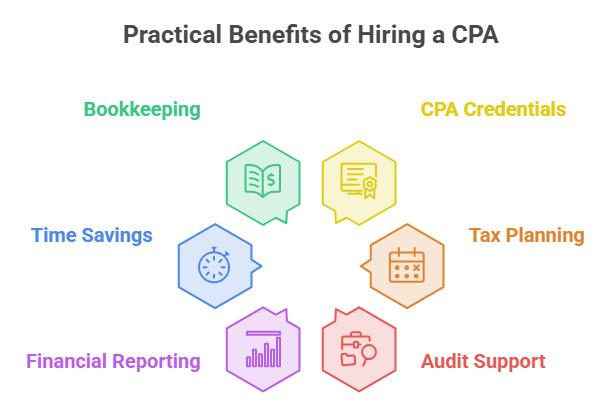
The benefits of hiring a CPA extend well beyond having someone file a return at the end of the year. For business owners across Houston and Texas who are managing payroll, navigating tax obligations, and trying to make informed financial decisions while running daily operations, a CPA can serve as a consistent and reliable financial partner rather than a once-a-year resource.
Business owners may initially view CPA services primarily as a compliance expense, but an ongoing CPA relationship can also support tax planning, financial reporting, bookkeeping, and other financial needs throughout the year.
A CPA Brings Credentials That Matter
Before addressing the specific benefits of hiring a CPA, it helps to understand what distinguishes a CPA from a general accountant or tax preparer. A Certified Public Accountant holds a state-issued license, has passed a comprehensive exam, and maintains ongoing continuing education requirements.
CPAs have unlimited representation rights before the IRS, while other tax return preparers may have limited or no representation rights depending on their credentials and participation in IRS programs.
For business owners who want a single professional relationship that covers both preparation and representation, a licensed CPA tends to be the more complete option.
Tax Planning and Compliance Throughout the Year
One of the most consistent benefits of hiring a CPA is access to year-round tax planning rather than a reactive once-a-year filing conversation. Tax law changes regularly, and a CPA who stays current with those changes can identify how they affect a specific business before the filing deadline rather than after.
A few areas where ongoing CPA involvement tends to add value include:
- Identifying deductible business expenses that may otherwise be missed or miscategorized.
- Timing significant purchases or depreciation to align with years where tax exposure is higher.
- Calibrating quarterly estimated tax payments based on current year income rather than prior year assumptions.
- Reviewing whether the current business structure remains appropriate from a tax perspective given current revenue and operations.
Proactive tax planning can provide an opportunity to review expense classifications, estimated tax payments, business structure, and other tax considerations before the annual return preparation process begins. Those who want to explore what that year-round engagement looks like may find it useful to review what dedicated tax planning support involves.
IRS Notice and Examination Support
Another of the practical benefits of hiring a CPA is having a credentialed professional available if the IRS raises questions about a return. An IRS notice is not automatically a sign of a major tax problem, but it should be reviewed carefully and addressed within the response deadline when action is required.
A CPA can help organize the response process, identify relevant documentation, communicate with the IRS when authorized, and help the business address applicable response deadlines.
According to the AICPA, the CPA license represents a high level of accounting expertise and competence, with licensing and continuing education requirements that vary by state.
Better Financial Reporting and Decision Support
Beyond tax work, one of the more practical benefits of hiring a CPA is the effect on financial reporting. When a CPA is involved in organizing financial records, the resulting reports can provide business owners with more structured financial information for internal decision-making. Those reports can provide additional financial context when business owners evaluate matters such as hiring, pricing, vendor relationships, and larger investments.
Consistent monthly financial reporting can give Houston business owners additional information beyond the current bank balance when evaluating the financial position and activity of the business.
Houston business owners who receive consistent monthly financial reports tend to make more confident operational decisions than those who are working from memory or an outdated bank balance. Connecting that reporting function to accounting support can help translate raw bookkeeping data into reports that are genuinely useful throughout the year.
Time Savings and Operational Focus
One benefit of hiring a CPA that is sometimes harder to quantify but consistently valued by business owners is time. Managing payroll, reconciling accounts, tracking deductible expenses, and staying current with filing obligations takes meaningful time, and that time tends to come from somewhere in the business.
For owners whose attention is most valuable when directed toward clients, operations, and growth, delegating the financial heavy lifting to a CPA creates space for that focus. Delegating appropriate accounting and tax responsibilities can allow business owners to devote more of their time to clients, operations, and other responsibilities within the business.
Delegating financial recordkeeping and tax preparation can also reduce the number of accounting and filing responsibilities the business owner must manage personally. That shift in how tax season feels is one of the more consistently mentioned benefits of hiring a CPA among the clients we work with.
Bookkeeping as the Foundation
The benefits of hiring a CPA are most fully realized when the underlying financial records are organized and current. A CPA who receives clean, well-maintained books can focus on planning, reporting, and advisory conversations rather than spending time sorting through unreconciled accounts before any meaningful work can begin.
Business owners who invest in consistent support through bookkeeping services alongside CPA engagement tend to get more from both functions because the two work together rather than the CPA having to compensate for gaps in the underlying records.
FAQs
What are the main benefits of hiring a CPA for a small business?
IRS representation rights, year-round tax planning, organized financial reporting, potential time savings for the business owner, and access to a credentialed professional who can support financial discussions throughout the year.
How is a CPA different from a general accountant or tax preparer?
A CPA holds a state-issued license, has passed a comprehensive licensing exam, and maintains ongoing continuing education requirements. CPAs also hold the representation rights before the IRS, which unlicensed preparers generally do not.
Can a CPA help if a business receives an IRS notice?
Yes. A licensed CPA can review the notice, determine what documentation may be needed, communicate with the IRS when authorized, and help the business address applicable response requirements and deadlines.
How does hiring a CPA help with financial decision-making?
A CPA can translate financial records into meaningful reports such as cash flow statements and PnL summaries. Those reports may help business owners make more informed decisions around hiring, investment, pricing, and operational planning throughout the year.
The Right Financial Partner Makes Running a Business More Manageable
The benefits of hiring a CPA show up most clearly not in any single tax season but across the full calendar year when the relationship is built around consistent support, organized records, and proactive planning rather than reactive compliance.
For business owners in Houston and across Texas who want a CPA relationship that reflects the genuine financial needs of a growing business, Dabney Tax & Accounting Services is available to help. Starting that conversation before a deadline or a problem arrives is almost always the more practical choice.


