

Texas franchise tax is a privilege tax applied to most legal entities doing business in the state, and understanding how it works is an important part of staying in good standing with the Texas Comptroller of Public Accounts. For business owners across Houston and Texas, knowing the filing requirements, calculation methods, and deadlines may help avoid penalties and keep the process more organized each year.
We work with Texas businesses that want to stay current with their franchise tax obligations without the confusion that often comes from navigating the rules independently. In our experience, the businesses that manage this process most smoothly are those that understand their specific filing category well before the May 15 deadline arrives.
What Is Franchise Tax in Texas
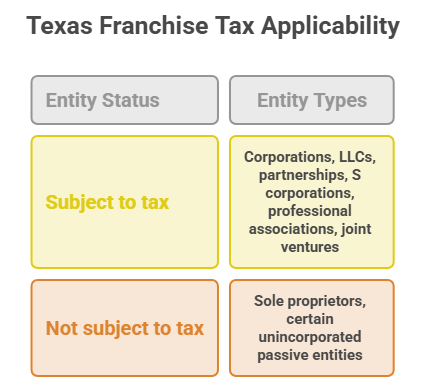
Franchise tax in Texas is not an income tax. It is a tax on the privilege of doing business in the state, calculated based on a business’s margin rather than its net profit. Most legal entities operating in Texas are subject to this tax, including corporations, LLCs, partnerships, S corporations, professional associations, and joint ventures.
What is Texas franchise tax applying to in terms of exemptions? Sole proprietors and certain unincorporated passive entities are generally not subject to the tax. Understanding whether a specific entity type is subject to the tax is the first step in the filing process.
Who Needs to File and Who Does Not Owe Tax
For the 2026 Texas franchise tax report, the no-tax-due threshold is $2.65 million in annualized total revenue. Taxable entities at or below this threshold generally do not owe franchise tax and are not required to file a No Tax Due Report, but they generally must still file the applicable Public Information Report or Ownership Information Report.
Businesses above the threshold must calculate their taxable margin and pay accordingly. A few points worth noting include:
- Passive entities may be exempt from paying but may still need to file specific forms.
- Single-member LLCs are considered taxable entities in Texas even though they are disregarded for federal tax purposes.
- Entities at or below the no-tax-due threshold generally file the applicable PIR or OIR without filing a franchise tax report, while entities above the threshold may still have franchise tax reporting requirements even when no tax payment is ultimately due.
Texas business owners, particularly those operating single-member LLCs, are generally unaware that they have a franchise tax filing obligation even when revenue is below the threshold. Connecting that obligation to a broader tax planning conversation early in the year tends to reduce the likelihood of a missed filing.
How to Calculate Texas Franchise Tax
For entities required to calculate taxable margin using the Long Form, Texas generally provides three primary margin calculations, subject to applicable eligibility and deduction rules:
- Total revenue minus allowable cost of goods sold;
- Total revenue minus allowable compensation; or
- 70% of total revenue.
Qualifying entities may instead elect to use the E-Z Computation method. The appropriate method depends on the entity’s circumstances and the deductions for which it qualifies.
Once the margin is determined using the chosen method, it is multiplied by the applicable tax rate. For 2026, the E-Z Computation is generally available to qualifying entities with annualized total revenue of $20 million or less and applies a 0.331% rate to apportioned total revenue. Businesses electing the E-Z Computation generally cannot take margin deductions such as cost of goods sold or compensation or claim franchise tax credits, so the available methods should be evaluated before filing.
How to Fill Out and File Texas Franchise Tax
To fill out Texas franchise tax filings, businesses log into the Texas Comptroller Webfile system using their 11-digit taxpayer number and Webfile access number. The online portal guides filers through the appropriate report based on their revenue level and entity type.
The annual Texas franchise tax filing deadline is May 15 every year. If it is a holiday or weekend on May 15, the deadline moves to the next working day. Extensions are available through the Comptroller’s website and must be requested before the original deadline.
A few items typically needed to complete the filing include:
- The federal income tax return for the applicable year
- Total revenue figures for the reporting period
- Supporting documentation for the chosen margin calculation method
- Payroll and compensation records if using the compensation deduction method
As per the Texas Comptroller of Public Accounts, the filing requirements and thresholds are reviewed periodically, and businesses should confirm current figures before filing each year.
Penalties for Missing the Deadline
Missing the May 15 Texas franchise tax filing deadline can result in penalties. Late filings generally carry a 5 percent penalty on any tax due, which increases to 10 percent if the report remains unfiled after a specified period. Interest may also apply to unpaid amounts.
For businesses that consistently file on time but find the calculation process challenging, maintaining organized financial records throughout the year through bookkeeping services tends to make the annual filing process more manageable. Having current revenue and payroll figures readily available before the filing window opens can make the information needed for the annual filing process easier to identify and organize.
How Franchise Tax Connects to Business Tax Preparation
Texas franchise tax filing is one component of a broader set of annual business tax obligations. For many Texas businesses, the franchise tax report and the federal business tax return involve overlapping financial data, including total revenue figures, compensation records, and cost of goods sold calculations.
Coordinating franchise tax preparation with federal business tax preparation can allow the same underlying financial information to be considered across both filings. This can also provide an opportunity to compare relevant revenue, compensation, and cost-of-goods-sold information for consistency.
FAQs
How do I fill out Texas franchise tax in 2026?
For the 2026 report year, taxable entities with annualized total revenue of $2.65 million or less generally do not file a No Tax Due Report but must still file the applicable Public Information Report or Ownership Information Report, unless an exception applies.
How do I calculate my franchise tax in Texas?
First, determine whether annualized total revenue exceeds the applicable no-tax-due threshold, which is $2.65 million for the 2026 report year. Entities required to calculate franchise tax should evaluate the applicable Long Form margin calculations and, when eligible, the E-Z Computation method to determine the appropriate filing approach.
Does a single-member LLC need to file a Texas franchise tax return?
Yes. A single-member LLC is considered a taxable entity in Texas even though it is treated as a disregarded entity for federal tax purposes. Whether tax is owed depends on total annual revenue relative to the no-tax-due threshold, but a filing obligation generally exists regardless.
What is the franchise tax in Texas for businesses under the revenue threshold?
For the 2026 report year, taxable entities with annualized total revenue of $2.65 million or less generally owe no franchise tax and are not required to file a No Tax Due Report. They generally must still file the applicable Public Information Report or Ownership Information Report.
Staying Current With Texas Franchise Tax Keeps the Business in Good Standing
Texas franchise tax filing is an annual obligation that rewards organized preparation and consistent financial recordkeeping. Understanding what franchise tax is in the Texas context, knowing which calculation method applies, and filing by the May 15 deadline are the three core elements of a manageable process.
For businesses across Houston and Texas that want CPA-led support for their franchise tax filing and broader annual tax obligations, Dabney Tax & Accounting Services is available to help. Connecting before the deadline rather than after it arrives is always the more practical approach.


