

The accrual vs cash accounting decision is one of the more foundational choices a business owner makes, and it affects how financial performance is measured, how taxes are reported, and how useful the books are for planning purposes. Getting this decision right early tends to save considerable effort later, particularly as a business grows and reporting needs become more complex.
We work with business owners across Houston and Texas who are either setting up their books for the first time or reconsidering their current method as their operations have changed. In our experience, the right choice depends on the specific nature of the business rather than a single universal recommendation.
How Each Method Works
Cash Accounting
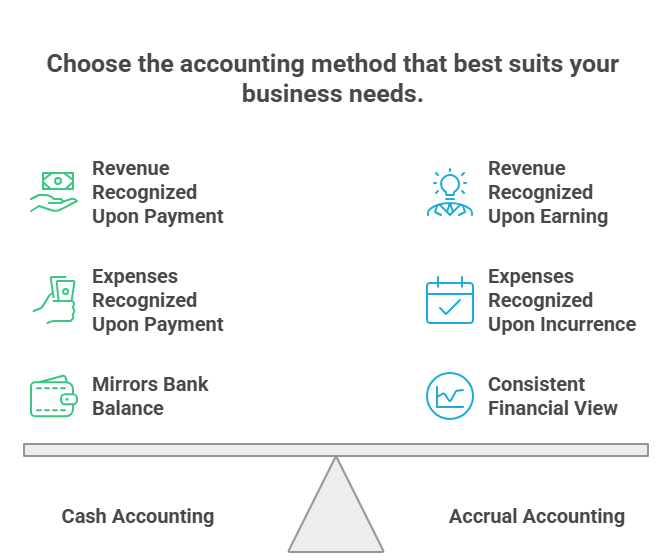
Cash-basis accounting recognizes revenue when payment is received and records expenses when the business actually pays them. A service completed in December but paid in January would appear as January income under this method.
This approach is straightforward and tends to mirror the business’s bank balance closely. For small service-based businesses with simple operations and immediate payment arrangements, it can be a practical and manageable approach.
Accrual Accounting
With the accrual method, transactions are reflected in the books based on when the business earns revenue or becomes responsible for a cost, rather than when the associated money changes hands. A service completed in December is recorded as December income even if the payment arrives in January.
This method tends to produce a more consistent view of financial performance across periods because revenue and the expenses associated with generating it are recorded in the same timeframe.
Key Differences at a Glance
| Factor | Cash Accounting | Accrual Accounting |
| When income is recorded | When cash is received | When earned |
| When expenses are recorded | When cash is paid | When incurred |
| Complexity | Lower | Higher |
| Timing focus | Short-term | Long-term |
| GAAP compliant | Generally no | Yes |
| Common considerations | Often used by qualifying small businesses with simpler transactions | Often useful when receivables, payables, inventory, or GAAP reporting are important |
Which Method Fits Your Business
Consider Cash Accounting If:
- The business is a sole proprietorship, freelance operation, or very small service business.
- Transactions are primarily immediate with no invoicing on credit terms.
- The business does not carry inventory.
- Simplicity and lower bookkeeping cost are priorities.
Consider Accrual Accounting If:
- The business sells goods on credit or carries physical inventory.
- Lenders or investors require financial statements prepared under GAAP.
- The business no longer qualifies for applicable small-business exceptions under the IRS gross-receipts test or is otherwise required to use an accrual method for federal tax purposes.
- Leadership needs a consistent month-to-month view of actual financial performance.
As a business grows, cash-basis reporting may provide less visibility into profitability when significant receivables, payables, or other timing differences develop. In those circumstances, accrual reporting may provide a more complete picture of financial performance.
Legal and Tax Considerations
The accrual vs cash accounting decision is not always entirely discretionary. Tax law and IRS rules place certain requirements on businesses depending on their size and structure.
Businesses for which inventory is an income-producing factor generally must account for inventory and may be required to use an accrual method for purchases and sales. However, qualifying small business taxpayers may be eligible for exceptions that allow different inventory treatment and continued use of the cash method.
According to the IRS guidance, the method used must clearly reflect income, and the IRS may require a change if the current method does not meet that standard.
Many smaller service-based businesses qualify to use the cash method for both bookkeeping and tax purposes. However, as revenue grows, it is worth reviewing whether the current method still meets the applicable requirements and whether it continues to produce reporting that is useful for management decisions.
How the Choice Affects Tax Timing
One practical dimension of the accrual vs cash accounting decision that business owners often overlook is the effect on tax timing. Under cash accounting, taxes are generally owed on income when it is received. This generally means income received in January for work performed in December is recognized in the following tax year, subject to constructive-receipt and other applicable tax rules.
Under accrual accounting, income is realized when earned regardless of when the cash arrives. This can create situations where a business shows taxable income in a period when the cash has not yet been collected, which may affect estimated tax payment planning.
Connecting the accounting method decision to a broader tax planning conversation tends to produce a more informed outcome, particularly for businesses where income timing varies significantly across the year.
The LLC Question
For small LLCs, the cash vs accrual accounting question is one that comes up frequently. Many qualifying small businesses, including LLCs, use cash-basis accounting because it can be simpler to maintain and generally recognizes income when it is actually or constructively received.
The case for switching to accrual accounting tends to become stronger when an LLC begins carrying inventory, extends credit to customers, seeks outside financing, or reaches a revenue level where a more consistent financial picture is needed for management and reporting purposes.
Reviewing that decision periodically with a CPA rather than making it once and never revisiting it tends to keep the method aligned with where the business actually is.
For businesses that want to connect their bookkeeping method to broader financial visibility, support through accounting services can help translate the numbers into reports that are genuinely useful for management decisions throughout the year.
How Bookkeeping Support Connects to This Decision
Whichever method a business selects, consistent and organized bookkeeping is what makes it work in practice. A business using accrual accounting without disciplined recordkeeping may find that accounts receivable and accounts payable are not being tracked properly, which undermines the value of the method entirely.
We find that businesses which maintain their books consistently through bookkeeping services tend to get more value from whichever accounting method they are using because the underlying data is current, organized, and reflective of actual business activity rather than being reconstructed periodically from memory.
FAQs
How do I select between cash and accrual accounting?
Cash accounting tends to work well for small, simple businesses with no inventory and immediate payment arrangements. Accrual accounting tends to be more appropriate when the business tracks inventory, invoices customers with delayed payment terms, or needs a consistent long-term view of profitability.
How can I tell which accounting method my business currently uses?
Checking whether accounts receivable and accounts payable appear on the balance sheet is a practical starting point. It is using accrual accounting if the business records revenue when invoices are sent and expenses when bills are received. If it only records transactions when cash moves, it is using cash accounting.
Should an LLC use cash or accrual accounting?
Whether an LLC should use cash or accrual accounting depends on its federal tax classification, size, inventory, reporting requirements, financing needs, and operations. Many qualifying small businesses use the cash method for simplicity, while accrual accounting may become more useful or required as the business becomes more complex.
Can an organization switch from cash to accrual accounting after it has already started?
Yes. However, changing an accounting method for federal tax purposes generally requires IRS consent and may require filing Form 3115, Application for Change in Accounting Method. A CPA can help determine the applicable requirements before a change is made.
Choosing the Method That Fits Where the Business Is Going
The accrual vs cash accounting decision is worth revisiting periodically rather than treating it as a one-time choice. As a business grows, changes its revenue model, or takes on new financial obligations, the method that worked in the earlier stage may no longer serve the business as well.
For business owners across Houston and Texas who want to review their accounting method and connect it to a broader financial strategy, Dabney Tax & Accounting Services is available to help. Getting that foundation right early tends to make every financial conversation that follows considerably more productive.


