

Tax planning strategies for high-income earners require a more deliberate, year-round approach than what most standard filing conversations involve. We work with high-income individuals and business owners across the Houston area who recognize that their tax position deserves more than a once-a-year review.
The complexity of managing significant income, investment activity, and business interests means that proactive planning tends to matter considerably more at higher income levels than it does for simpler financial situations. This blog walks through some of the more commonly discussed approaches that high-income earners may want to explore with a qualified tax professional.
Why High-Income Earners Face a Different Tax Landscape
Higher income doesn’t just mean a larger tax bill. It often means a more complex one. Phase-outs for certain deductions and credits, exposure to the Net Investment Income Tax, and the potential for significant capital gains activity all create a tax picture that benefits from careful, consistent attention throughout the year.
For Houston-area professionals in industries like energy, healthcare, and executive leadership, income patterns can also be irregular, with bonuses, equity compensation, and project-based earnings creating variability that makes year-round planning particularly valuable.
Working with a CPA who understands both federal tax law and Texas-specific considerations may help with tax planning strategies for high-income earners with more organized year-round tax review.
Retirement Accounts and Tax-Advantaged Vehicles
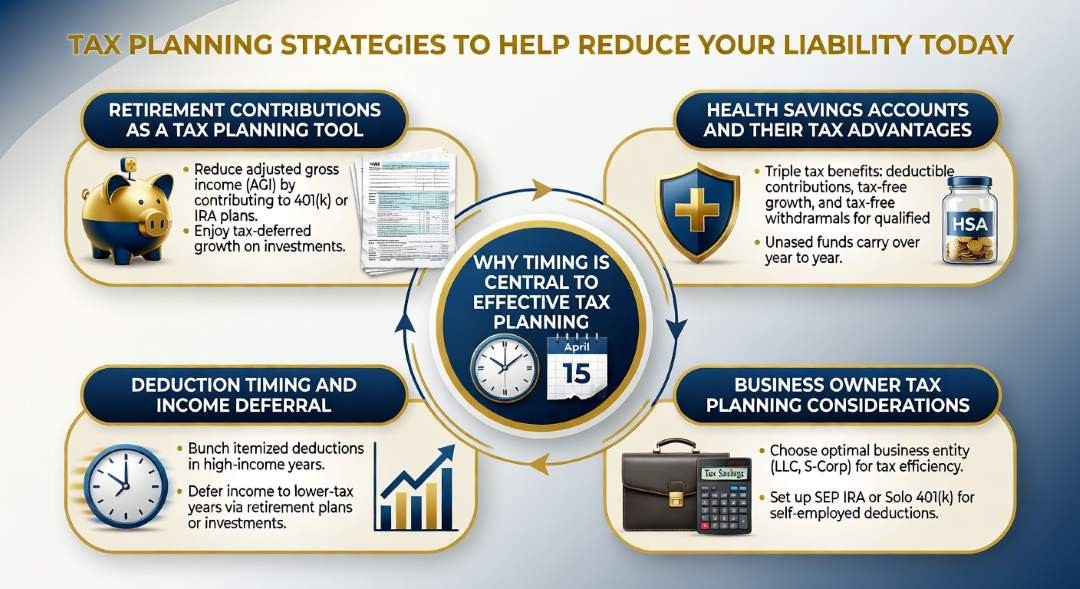
One of the more foundational tax planning strategies for high-income earners involves making full use of available tax-advantaged retirement accounts. For 2026, the 401(k) contribution limit sits at $24,500, or $32,500 for those aged 50 and older. Fully funding these accounts may help reduce taxable income for the year, which can be meaningful for earners in higher federal brackets.
Health Savings Accounts are another vehicle worth discussing with a tax professional for those enrolled in a qualifying high-deductible health plan. The combination of potentially deductible contributions, tax-free withdrawals, and tax-free growth for qualified medical expenses makes HSAs a frequently cited component of broader planning conversations for high-income individuals.
For those whose income exceeds the direct Roth IRA contribution limits, a backdoor Roth IRA conversion is an approach that some high-income earners explore with professional guidance.
Charitable Giving as a Planning Tool
For tax planning strategies for high-income earners who give charity, the structure and timing of those contributions can carry meaningful tax implications. A few approaches that come up regularly in planning conversations include:
- Donor-advised funds, which allow donors to contribute in a given tax year.
- Donating appreciated securities rather than cash.
- Qualified charitable distributions from IRAs may provide tax benefits for certain taxpayers, even when itemizing deductions is not the most beneficial option. Qualified charitable distributions generally apply to IRA owners age 70½ or older.
The specific tax treatment of each approach depends on individual circumstances and applicable IRS rules. These are among the tax planning strategies for high-income earners that benefit most from early, deliberate planning rather than last-minute decisions made in the final weeks of the tax year.
For individuals looking for a broader planning framework, tax planning support designed around complex financial situations may provide a more structured starting point.
Capital Gains Management and Investment-Related Planning
High-income earners with active investment portfolios often focus on managing capital gains as part of their overall tax planning. Tax-loss harvesting, which includes selling underperforming investments to offset gains, is one approach sometimes used alongside financial and tax advisors.
Investment-related tax planning typically requires coordination between financial professionals and tax advisors, especially for individuals with complex portfolios. For business owners planning a sale, acquisition, or ownership transition, discussing the potential tax implications with a qualified CPA well before finalizing any agreement can help support more informed decision-making.
Individuals who want to connect their investment-related tax considerations with their broader filing picture may find that individual tax preparation handled alongside proactive planning conversations supports a more complete and coordinated approach.
Business Owner Considerations at Higher Income Levels
For high-income business owners across the Houston area, from professional practices in the Medical Center district to service firms in The Woodlands, tax planning often becomes more complex due to business structure, compensation design, and retirement plan choices.
SEP IRAs and defined benefit plans may allow significantly higher contributions in certain situations compared to standard retirement accounts, making them important considerations for self-employed professionals and established business owners. Well-maintained financial records also play a key role in supporting deductions and year-round planning decisions.
Key areas where higher-income business owners often benefit from professional guidance include retirement plan selection and timing (such as SEP IRA, SIMPLE IRA, and defined benefit plans), compensation structure planning, and quarterly estimated tax reviews to help manage cash flow and avoid underpayment issues.
For business owners who want that kind of financial foundation in place, bookkeeping and payroll services maintained alongside regular tax planning check-ins can support a more connected and proactive approach.
FAQs
At what income level does more advanced tax planning typically become relevant?
There is no single threshold, but planning conversations tend to become more involved as income increases and financial complexity grows. Individuals with significant investment income, equity compensation, business ownership, or multiple income sources generally benefit from more structured, year-round planning regardless of a specific dollar figure.
How does the Net Investment Income Tax impact high-income earners?
The NIIT is an additional 3.8% of tax that may be applied to certain investment earnings once the modified adjusted gross income crosses defined thresholds. It can influence how capital gains and dividends are taxed and is an important consideration in overall tax planning. A CPA can help assess how it may apply in an individual case.
Can high-income earners still benefit from charitable deductions if they take the standard deduction?
Charitable deductions typically benefit taxpayers who itemize. However, tools like Donor-Advised Funds and qualified charitable distributions from IRAs may provide alternative ways to support charitable giving when itemizing is not the most beneficial option. A tax professional can help determine what may apply in a specific situation.
How far in advance should high-income earners begin their year-end tax planning conversations?
Earlier planning tends to be more effective. Key decisions like retirement contributions, charitable giving timing, and estimated tax payments are often best addressed in the third quarter or earlier, since waiting until later in the year can limit available options and reduce flexibility to make meaningful adjustments.
Take a More Proactive Approach to Your Tax Position
Managing taxes at higher income levels often requires more than a once-a-year filing conversation. If your income, investments, business ownership, or compensation structure has become more complex, year-round tax planning may help you review available options before key deadlines arrive. Dabney Tax & Accounting Services works with Houston-area individuals and business owners to support more organized tax planning conversations throughout the year.


