

Effective tax planning strategies are something many Houston business owners and individuals think about only when tax season is already underway, which is often too late to act on the options that could have made the most meaningful difference.
This blog walks through some of the more commonly discussed tax planning strategies for individuals and business owners, and why approaching them early in the year tends to produce better results than waiting until April.
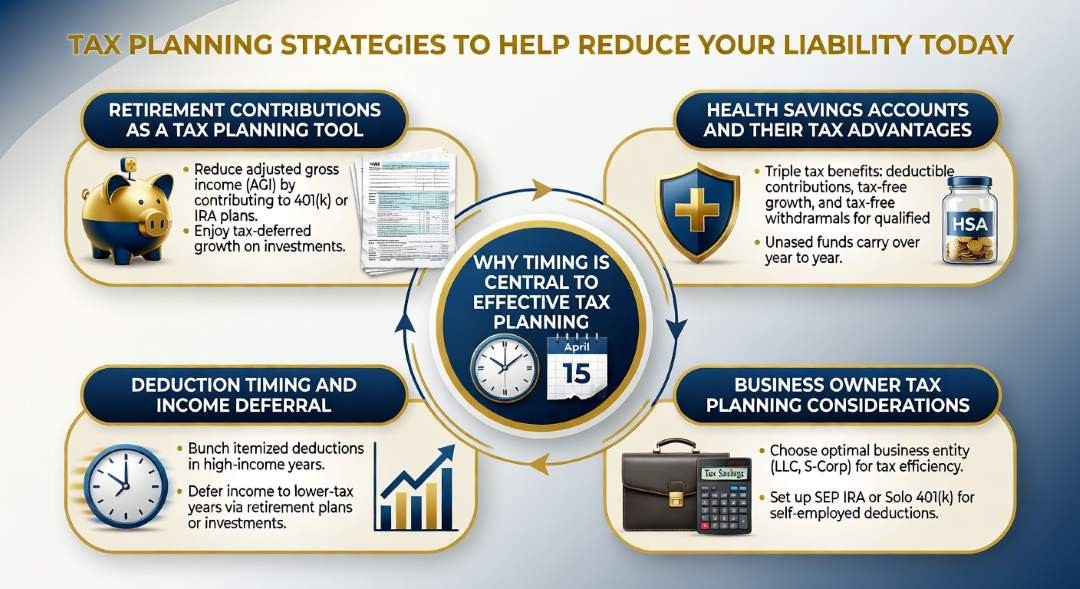
Why Timing Is Central to Effective Tax Planning
One of the most important things to understand about tax planning strategies is that many of them are time-sensitive. Decisions about retirement contributions, expense timing, and income deferral only carry potential tax benefits if they are made before the relevant deadline passes. Once the tax year closes, the options available to reduce liability narrow considerably.
For business owners in the Energy Corridor managing variable project-based income, or salaried professionals in the Sugar Land area experiencing a significant income change during the year, connecting with a tax professional well before year-end may support more informed decisions about how to approach the remainder of the year from a tax perspective.
We encourage clients to think of tax planning as a year-round conversation rather than a once-a-year event. That shift in mindset tends to open up more options and reduce the last-minute stress that many taxpayers associate with filing season.
Retirement Contributions as a Tax Planning Tool
Contributing to retirement accounts is one of the more widely discussed tax planning strategies for both individuals and business owners, and for good reason. Traditional IRA and 401(k) contributions may reduce taxable income for the year in which contributions are made, which can be a meaningful consideration for individuals in higher income brackets.
For 2026, the IRS allows IRA contributions of up to $7,500, or up to $8,600 for taxpayers age 50 or older when the $1,100 catch-up contribution is included. Employer-sponsored retirement plans such as 401(k) plans generally allow higher employee contribution limits, with a 2026 elective deferral limit of $24,500 before any applicable catch-up contributions.
For self-employed professionals and small business owners, SEP IRA and SIMPLE IRA contributions offer additional options worth discussing with a qualified tax professional. These plans generally allow higher contribution limits than traditional IRAs and, in many cases, can be funded up until the tax filing deadline, including extensions, which provides a degree of planning flexibility that other options don’t always offer.
It is important to note that the tax treatment of retirement contributions depends on individual circumstances, and a tax professional can help you understand which options may be relevant to your specific situation.
Health Savings Accounts and Their Tax Advantages
Health Savings Accounts, commonly referred to as HSAs, are sometimes overlooked in discussions about tax planning strategies, but they offer a combination of tax benefits that makes them worth understanding. Contributions to an HSA may be tax-deductible, growth within the account is generally tax-free, and withdrawals used for qualified medical expenses are typically not subject to federal income tax.
Connecting with a professional who offers tax planning support can help frame these decisions within the context of your overall financial situation.
Deduction Timing and Income Deferral
Two of the more nuanced tax planning strategies that come up frequently in our client conversations involve the timing of deductions and the deferral of income. Both approaches are based on the same underlying principle: the tax year in which income is recognized or a deduction is claimed can affect how that item is taxed.
For individuals who are close to the standard deduction threshold, grouping or “bunching” deductible expenses such as charitable donations or certain medical costs into a single tax year may allow them to surpass the standard deduction and benefit from itemizing.
Income deferral, where feasible, involves postponing the recognition of income into a future tax year when a lower tax bracket is anticipated.
Both of these approaches involve nuances that depend heavily on individual circumstances. To understand how these considerations might apply to your situation, individual tax preparation support combined with proactive planning conversations can provide a more complete picture.
Business Owner Tax Planning Considerations
For small business owners across the Houston area, from service providers in Pearland to contractors working in the greater Woodlands corridor, tax planning strategies tend to involve a somewhat broader set of considerations than those relevant to salaried individuals.
Deductible business expenses are a foundational part of business tax planning. Office supplies, equipment purchases, professional subscriptions, vehicle mileage used for business purposes, and certain travel costs are among the categories that may be deductible depending on how they are used and documented.
Quarterly estimated tax payments are another area where business owners frequently benefit from professional guidance. Underpaying estimated taxes can result in penalties, while significant overpayment ties up cash that could otherwise be used in the business.
For businesses that want to connect their ongoing bookkeeping with their tax planning conversations, bookkeeping and payroll services maintained alongside regular planning check-ins may support a more informed and connected approach to both functions.
FAQs
How early in the year should I start thinking about tax planning strategies?
From a practical standpoint, the beginning of the year is an ideal time to revisit your tax position, particularly if your income or financial situation changed significantly in the prior year. Mid-year check-ins are also valuable, as they allow enough time to make meaningful adjustments before the year closes. Waiting until the final weeks of the year limits the options available.
Are tax planning strategies different for self-employed individuals compared to employees?
In many respects, yes. Self-employed professionals generally have more flexibility in managing the timing of income and expenses, but they also carry additional responsibilities such as quarterly estimated payments and self-employment tax obligations.
Can charitable contributions be part of a broader tax planning approach?
Charitable donations to qualified organizations may be deductible for taxpayers who itemize their deductions. The timing and structure of charitable giving can also play a role in planning conversations, particularly for individuals who are close to the standard deduction threshold or considering donating appreciated assets rather than cash.
What records should I keep to support the tax planning strategies I implement?
Documentation is an important part of supporting any deduction or credit claimed on a tax return. Business expense receipts, retirement account contribution confirmations, charitable donation acknowledgment letters, and mileage logs are among the records most commonly needed.
Start the Conversation Before the Year Slips Away
Proactive tax planning strategies work best when there is still time to act on them. Whether you are a business owner in the Houston area evaluating your quarterly estimated payments or an individual navigating a significant income change, the earlier that conversation begins, the more options tend to be available.
For professional support, you can visit us at Dabney Tax & Accounting Services. We help Houston-area clients throughout the year to support more informed, timely planning conversations that support more organized planning conversations before filing season.


