

Knowing how to hire an accountant can be an important decision for business owners across Houston as their financial needs become more structured.
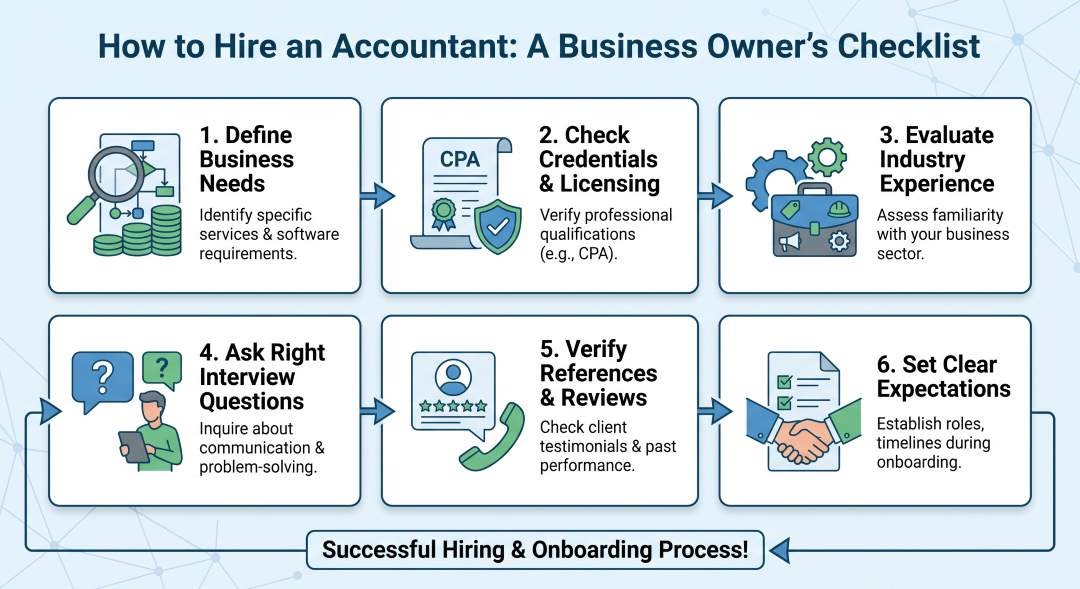
In our years working with small and mid-sized businesses, we have seen that hiring an accountant involves understanding what the business actually needs, evaluating credentials and experience, asking the right questions, and setting clear expectations from the start. It is less about finding the cheapest option and more about finding the right fit for the business’s goals.
Start by Defining What the Business Actually Needs
Before asking how to hire an accountant, business owners may benefit from to take time to define what they need from an accountant. That clarity makes the hiring process much more focused and may help reduce misalignment later.
Some businesses need help with monthly bookkeeping and transaction categorization. Others need tax preparation and planning support. Still others may need payroll processing, financial statement preparation, or financial planning and analysis support. Understanding which services matter most can help narrow the search and set realistic expectations around cost and scope.
For businesses that need ongoing support with recordkeeping and payroll, bookkeeping & payroll services may be part of a broader accounting solution that also includes tax preparation and planning.
Check Credentials and Professional Licensing
Once a business owner knows what services are needed, the next step in hiring an accountant is verifying credentials. Not every accountant holds the same qualifications, and those differences can affect the level of service and representation available.
We have worked with businesses in The Heights, West University, and Clear Lake that initially hired bookkeepers, thinking they were getting full accounting support, only to realize later that tax preparation and planning were not included. Understanding the difference between these can help business owners set the right expectations and avoid gaps in service.
For businesses that need year-end filings and ongoing tax support, business tax preparation may be part of a comprehensive accounting relationship that includes both compliance and planning.
Evaluate Industry Experience and Business Familiarity
Another important factor in the “how to hire an accountant” scenario is industry experience. Houston is home to a wide range of businesses, from energy and construction to healthcare, professional services, and hospitality. Each industry has unique accounting patterns, reporting requirements, and tax considerations.
Accountants with experience in a specific industry are often more familiar with to handle the nuances that general accountants may not always address. For example, a construction company may need help with job costing and progress billing. An energy company may need support with joint interest billing and depletion allowances. A healthcare practice may face unique payroll structures and insurance reimbursement reporting.
For businesses that want clearer financial visibility and reporting tailored to their operations, financial reporting analysis may support better decision-making when paired with industry-specific accounting support.
Ask the Right Questions During the Interview Process
Once a short list of candidates is assembled, the interview process becomes critical. Key questions we recommend asking include:
- What services do you provide beyond tax preparation?
- Do you have experience working with businesses in my industry?
- What accounting software platforms do you work with?
- How do you communicate with clients throughout the year?
- Can you help with tax planning and estimated payments?
- What is your fee structure, and what is included?
These questions help clarify whether the accountant’s approach aligns with the business’s needs and expectations.
Verify References and Check Reviews
Another step in how to hire an accountant is checking references and reading reviews. Speaking with former clients can provide valuable insight into the accountant’s reliability, responsiveness, and quality of work.
Business owners may consider asking references about communication style, timeliness, consistency, and whether the accountant offers proactive advice or primarily reacts to requests. Those details can help business owners in Texas make more informed decisions about whether the accountant is a good fit.
A Case from Our Practice
Recently, we began working with a small service business in Downtown Houston that had been managing accounting with a part-time bookkeeper who handled transaction entry but did not prepare financial statements or offer tax planning. As the business added employees and expanded into new service areas, the owner realized they needed more comprehensive support.
During our initial conversations, we reviewed the business’s current recordkeeping, discussed tax planning opportunities, and set up a process for monthly financial reporting and quarterly tax check-ins. That shift provided the owner with clearer visibility into profitability, better support during tax season, and a clearer understanding when making financial decisions.
Looking at this case, this reflects a broader pattern where hiring an accountant often comes down to finding someone who can understand the business and provide support that evolves as needs change. Even according to the U.S. Small Business Administration, managing cash flow and financial records consistently helps keep your business running smoothly.
Set Clear Expectations During Onboarding
Once an accountant is hired, the onboarding process sets the tone for the relationship. We encourage business owners to provide access to necessary records, share financial software login information, and establish clear communication expectations from the start. Key onboarding steps may include:
- Providing access to bank accounts, credit cards, and accounting software
- Sharing prior year tax returns and financial statements
- Setting up a regular meeting schedule for financial review
- Clarifying what services are included and how billing works
In our experience, businesses that take time to onboard their accountant properly tend to have smoother relationships and fewer misunderstandings down the road.
FAQs
What credentials should I look for when hiring an accountant?
Look for credentials such as Certified Public Accountant or Enrolled Agent, which indicate professional training, licensing, and understanding of tax obligations.
How much does it typically cost to hire an accountant for a small business?
Costs vary based on services, complexity, and region. Some accountants charge hourly rates, while others use monthly retainers or flat fees. Typical ranges may be $150 to $400 per hour or $300 to $1500 per month for ongoing support. These ranges are general estimates and may vary based on service scope, business complexity, and location.
Should I hire an in-house accountant or outsource?
That depends on the business’s size, complexity, and budget. Outsourcing may be more cost-effective for small to mid-sized businesses, while larger companies may benefit from in-house staff.
What questions should I ask during the interview process?
Ask about services offered, industry experience, software proficiency, communication style, fee structure, and how the accountant stays current on tax laws and regulations.
Final Thoughts
Having an understanding of how to hire an accountant can help set the foundation for better financial organization, clearer reporting, and more confident decision-making.
In our experience, the best accounting relationships are supported by clear expectations, open communication, and a shared understanding of the business’s goals. For Houston business owners evaluating accounting support, our team at Dabney Tax & Accounting Services provides bookkeeping, tax preparation, and financial reporting services aligned with each business’s needs.


