

Employee benefit audits can feel overwhelming for businesses across Houston that sponsor retirement plans or other benefit programs subject to federal reporting rules. If your business offers a 401 (k) plan, pension, or certain health and welfare benefits to employees, there may come a time when an audit is required under the Employee Retirement Income Security Act, also known as ERISA.
For many companies in Houston, employee benefit audits represent a reporting requirement that involves detailed documentation, coordination with plan administrators, and preparation for review by outside auditors. The requirements vary based on plan type, participant count, and other details. Businesses should review their own plan documents and consult qualified professionals when preparing for or managing an audit process.
What Triggers an Audit Requirement
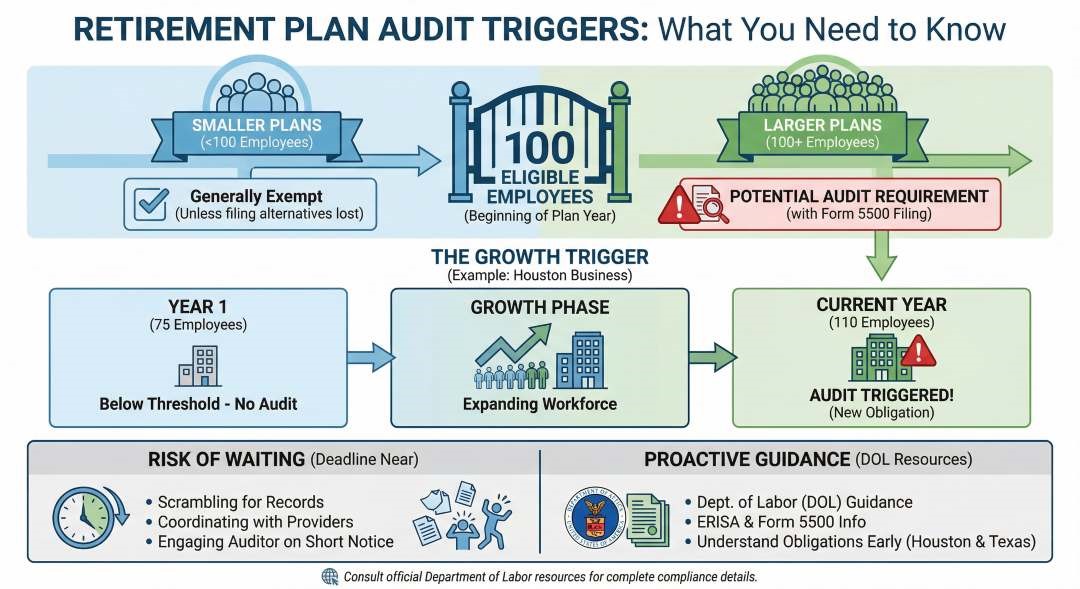
The general rule under Department of Labor guidance is that retirement plans with 100 or more eligible employees at the beginning of the plan year may be subject to an audit requirement when filing Form 5500. Smaller plans may be exempt unless they lose eligibility for certain filing alternatives.
For businesses in Downtown Houston, Midtown, or Cypress that have grown over time, this threshold can sneak up quietly. A company that started with 75 employees a few years ago may now have 110, and that shift can trigger new compliance obligations that were not previously required.
Understanding when employee benefit audits become necessary is often the first step. Businesses that wait until the Form 5500 deadline is near may find themselves working to locate records under time pressure, coordinate with service providers, and engage an auditor on short notice.
The Department of Labor provides guidance on ERISA plan requirements and Form 5500 filings. That resource may be useful for plan sponsors in Houston and across Texas trying to understand general filing and audit obligations.
How Preparation Affects the Audit Experience
One of the most consistent patterns across employee benefit audits we recognize is that preparation makes a difference. Businesses in The Heights, West University, and Clear Lake that stay organized throughout the year generally may experience a more organized audit process than those that start gathering records only after the auditor sends a document request list.
Preparation can include keeping payroll and contribution records aligned, reviewing plan documents for consistency, checking that employee deferrals match what was deposited, and confirming that eligibility and loan activity are properly documented.
For companies managing payroll in-house or through outside providers, bookkeeping payroll services can support better alignment between payroll records and benefit plan data throughout the year.
Common Areas Auditors Often Review
Auditors engaged to perform employee benefit audits typically focus on a few core areas. These may include participant eligibility, the consistency and timing of employer and employee contributions, participant loans, distributions, and whether the plan is being administered according to its governing documents.
Contribution timing is a frequent area of focus. The DOL generally expects employee deferrals to be deposited as soon as administratively feasible, which is often interpreted as a matter of days rather than weeks. Delays in depositing contributions may raise questions during review and may lead to findings that require correction.
A Houston Area Situation Our Team Worked Through
A few years ago, a growing professional services firm in Pearland came to us shortly after learning their 401 (k) plan had crossed the 100 participant threshold. The business had never been audited before and was unsure what to expect. Records were scattered across payroll reports, third-party administrator statements, and internal spreadsheets.
As part of the engagement, the firm worked to centralize records, reconcile contribution amounts, and organize loan documentation before the auditor began fieldwork. That upfront effort did not eliminate all audit questions, but it did help the process move forward without major delays or surprises. The audit was completed within the filing timeline, and the Form 5500 was filed before the deadline.
This reflects a broader reality across Houston and surrounding Texas communities. Employee benefit audits are manageable when records are organized and when plan sponsors understand what auditors are likely to review.
Why Early Engagement With an Auditor Helps
Early engagement with an independent auditor may allow more time to plan fieldwork, request documents in phases, and address issues before they become urgent. It may also give the plan sponsor time to gather records, coordinate with payroll and plan administrators, and address any gaps before the formal audit begins.
For businesses managing both personal and business tax filings during the same season, individual tax preparation may also be part of the broader compliance picture, especially when plan sponsors are also business owners with pass-through income.
What Technology and Coordination Can Improve
Many auditors now use secure online portals to request and receive documents. This can may help streamline communication and minimize the risk of misplaced files. Plan sponsors in Memorial, Montrose, and Kingwood who adopt similar technology for internal tracking may find it easier to respond to requests quickly.
Coordination between payroll providers, third-party administrators, and recordkeepers is another area that can improve the audit process.
Businesses interested in year-round planning and coordination may find value in tax planning as part of a broader effort to stay organized across financial, payroll, and compliance obligations.
Recognizing When Outside Help Makes Sense
Employee benefit audits are technical, and not every business has internal staff with the time or expertise to manage the process alone. For smaller companies in Texas that do not have a dedicated HR or finance team, outside support may help with record organization and preparation ahead of an audit and reduce the risk of missing deadlines or filing errors.
FAQs
What is an employee benefit audit?
An employee benefit audit is generally a review of a company’s retirement or welfare benefit plan conducted by an independent auditor to verify that the plan is being administered according to its documents and applicable regulations.
What are the four types of employee benefits?
Common types of employee benefits include medical insurance such as health, dental, and vision coverage, life insurance, disability insurance covering short-term and long-term needs, and retirement plans like 401k or pension programs.
When is an employee benefit audit required?
Under DOL rules, retirement plans with 100 or more eligible employees at the beginning of the plan year are generally required to have an annual audit as part of the Form 5500.
How can businesses prepare for an employee benefit audit?
Businesses can prepare by organizing payroll and contribution records, reviewing plan documents, coordinating with third-party administrators, and engaging an auditor early in the year rather than waiting until the filing deadline is close.
Final Thoughts
For businesses across Houston, employee benefit audits are an important part of staying compliant with federal retirement plan rules. While the process can feel detailed and time-consuming, early preparation, organized records, and coordination with service providers may help simplify the experience and support timely filing.
At Dabney Tax & Accounting Services, our team understands the complexities of employee benefit plans. We work with Houston businesses to provide bookkeeping, payroll alignment, and documentation preparation that may assist businesses as they work with independent auditors.


