

Managing corporate payroll services can be a time-consuming process for businesses across Texas as they grow and add employees. In our work with companies, we have seen how payroll complexity increases as businesses hire more staff, operate in multiple locations, or navigate changing tax rules.
What may have started as a simple weekly or biweekly process can quickly become a challenge involving wage calculations, tax withholdings, compliance filings, benefits deductions, and year-end reporting. That is when many business owners begin exploring corporate payroll services as a way to support administrative processes and allow internal teams to focus more on other business activities.
Why Payroll Becomes More Complex as Businesses Grow
We have found that businesses often underestimate how much time payroll takes until they experience delays, errors, or compliance issues. Those problems can lead to frustrated employees, missed tax deadlines, and penalties that may create additional challenges with better systems or outside support.
Corporate payroll services are often reviewed by businesses that want to may help reduce the likelihood of errors, stay current on tax law changes, and streamline the payroll process so it takes hours instead of days. In our experience, payroll complexity is also about the variety of pay structures, the number of jurisdictions involved, and how well payroll integrates with other financial systems.
According to the IRS, businesses may incur tax penalties due to late filings or incorrect withholding calculations. That broader context reflects how critical payroll consistency and compliance are for businesses across Texas and nationwide.
What Corporate Payroll Services Typically Include
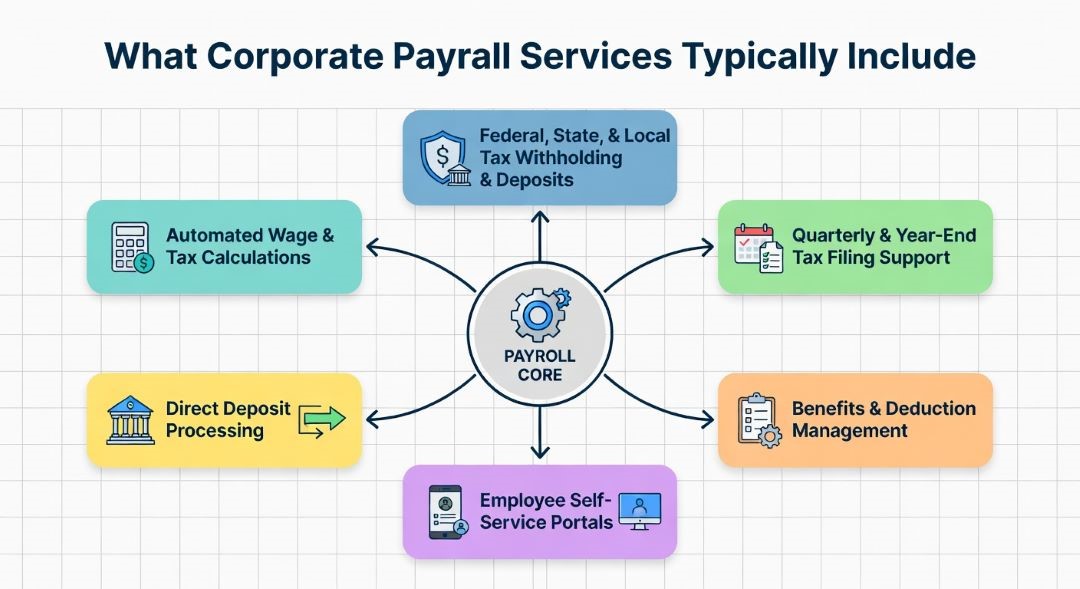
When businesses ask us about corporate payroll services, they are usually looking for more than just check printing. They want a solution that handles calculations, tax filings, compliance, and reporting in a consistent and reliable way. Common elements of it may include:
- Automated wage and tax calculations
- Federal, state, and local tax withholding and deposits
- Quarterly and year-end tax filing support
- Direct deposit processing
- Employee self-service portals for pay stubs and W-2 access
- Benefits and deduction management
For businesses in The Heights, West University, and Clear Lake that want payroll integrated with their broader accounting operations, bookkeeping payroll services may support a more organized approach to both recordkeeping and compensation management.
How Automation Reduces Errors and Saves Time
One of the main reasons businesses move toward corporate payroll services may help reduce manual errors and processing time. Manual payroll processing involves calculating hours, applying tax rates, tracking deductions, and preparing deposits and filings. Each of those steps creates an opportunity for mistakes, especially when rules change or staff turnover occurs.
Automated payroll systems handle many of those tasks with less manual input. They calculate gross pay, apply current tax rates, process deductions, generate direct deposits, and prepare tax filings based on updated regulations. That automation can reduce the time needed to run payroll and lower the risk of costly errors.
For businesses that also need year-end tax reporting and business filings, business tax preparation may be part of a broader relationship that includes payroll support and financial planning.
A Case Example from Our Practice
We recently began working with a growing construction company in Houston that was managing payroll manually using spreadsheets and a basic accounting program. As the company added field employees and office staff, payroll became increasingly difficult to manage.
After transitioning to corporate payroll services that included automated calculations, tax filing, and employee self-service access, the company reported more consistent payroll processing and more structured reporting. The owner also had a clearer view into labor costs by job, which supported better project budgeting and pricing decisions.
Why Compliance Matters More Than Ever
Businesses are generally required to meet payroll tax and reporting obligations. Businesses must withhold the correct amounts for federal, state, and local taxes, deposit those amounts on time, file quarterly and annual reports, and provide employees with accurate year-end forms. Mistakes can lead to penalties, interest, and audit issues that take time and money to resolve.
We have found that many business owners are not fully aware of how often payroll tax rules change or how many jurisdictions may be involved when employees work in different locations. Corporate payroll services that include automatic tax updates and compliance monitoring may help businesses stay organized around of missed filings or incorrect withholdings.
For businesses that want better visibility into payroll costs and trends, financial reporting analysis may support more informed decisions about staffing, budgeting, and labor allocation.
How Payroll Services Integrate With Broader Financial Systems
One of the most overlooked benefits of corporate payroll services is integration. When payroll data flows directly into the general ledger, financial reporting becomes more consistent. Businesses can see labor costs by department, project, or location without needing to manually transfer data from one system to another.
Integration also supports better planning. When payroll data is current and accessible, business owners may review labor costs in real time and make more informed decisions about hiring, scheduling, and budgeting.
FAQs
What are the 5 essential components of payroll?
The five key components are employee information such as W-4s and pay rates, accurate time tracking, gross pay calculations, tax withholdings, and final net pay distribution.
What is the most important part of payroll?
The most important part of payroll is accuracy and timeliness, which means employees are paid correctly and on time while tax obligations are met consistently.
Can payroll services help with tax compliance?
Yes. Many corporate payroll services include automatic tax calculations, timely deposits, and quarterly and year-end filing support to help businesses stay compliant with federal, state, and local requirements.
How do employee self-service portals improve payroll management?
Self-service portals allow employees to access pay stubs, W-2 forms, and year-to-date earnings on their own, which may reduce administrative inquiries and improves the overall employee experience.
Final Considerations
Managing payroll complexity with corporate payroll services may help reduce errors, improve compliance, and free up time for more strategic activities.
For businesses exploring payroll support, our team at Dabney Tax & Accounting Services provides bookkeeping, payroll coordination, and tax support aligned with each client’s reporting needs.


