

What is a fractional CFO?” is becoming a common question among Houston business owners trying to decide if part-time financial leadership is right for their company. A fractional CFO is generally an experienced financial professional who supports businesses with financial planning and analysis on a flexible, part-time basis.
For companies that are growing but not ready for a full-time finance executive, the question of whether to use a fractional CFO often becomes tied to cost, capacity, and long-term planning.
The Role Beyond Day-to-Day Accounting
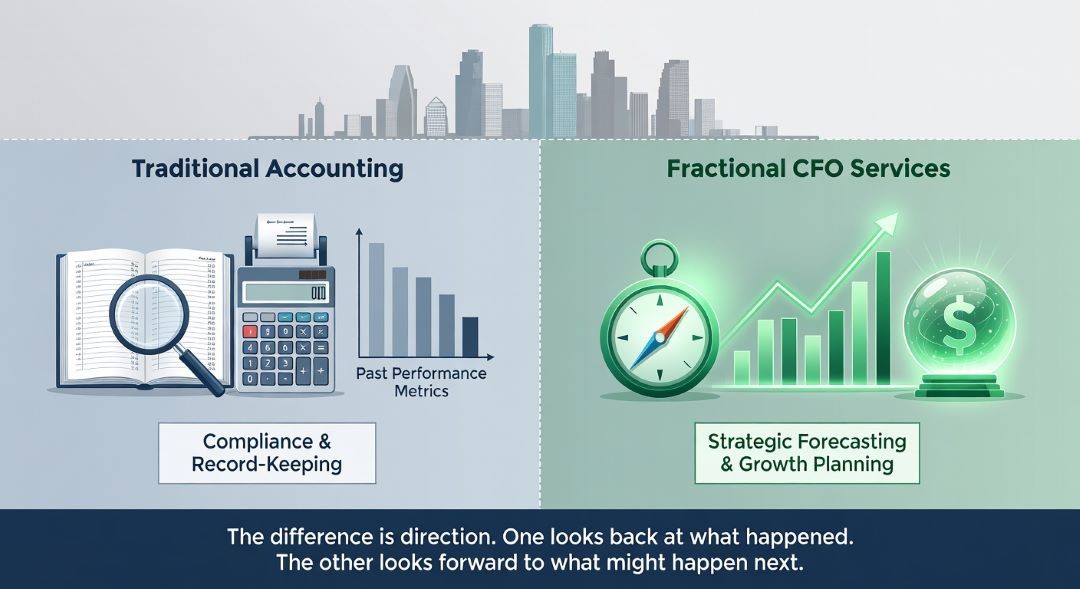
Many Houston business owners we speak with have a bookkeeper or accountant handling monthly records. However, they still feel uncertain about cash flow visibility, financial planning, or how to interpret the numbers they are seeing. The question of “What is a fractional CFO?” is less about replacing those functions and more about adding a layer of strategic insight.
For businesses managing regular bookkeeping needs in areas like Downtown Houston, Midtown, or Cypress, bookkeeping payroll services may still be the foundation, while a fractional CFO builds on that foundation with forward-looking analysis.
The difference is direction. One looks back at what happened. The other looks forward to what might happen next.
When Businesses Start Asking This Question
What is a fractional CFO usually comes up at certain turning points. Maybe a company in The Heights or West University is scaling faster than expected, and cash flow is harder to predict. Maybe a business owner in Clear Lake is considering a loan or outside funding and needs clearer projections. Or maybe leadership in River Oaks or Montrose wants better financial visibility before making decisions about hiring.
These are the moments when the question shifts from whether the books are consistent to whether the financial strategy makes sense. A fractional CFO may support a business in reviewing patterns, preparing for potential changes, and building financial models that reflect realistic assumptions rather than guesswork.
According to the SBA, access to capital and financial planning are among the top challenges small businesses face as they grow. That broader context helps explain why financial leadership is often considered even when a business is not large enough to justify a full-time executive.
What a Fractional CFO Typically Does Not Do
It helps to clarify what this role is not. A fractional CFO typically:
- Does not process invoices, reconcile accounts, or prepare tax returns.
- Is generally focused on interpreting data, building plans, and advising leadership.
For businesses in Sugar Land, Katy, or League City that need help with year-end filings or business returns, business tax preparation would typically remain a separate function. The fractional CFO might help prepare projections or review how tax obligations affect cash, but the filing itself is usually handled by a tax professional.
A Situation We Encountered in Houston
We once worked with a service business in Pearland that had grown from two employees to twelve in about eighteen months. Revenue had doubled, but the owner was not sure whether the business was actually more profitable or just busier. Payroll was increasing, expenses were harder to track, and decisions about adding staff or equipment were based mostly on instinct.
The business already had a bookkeeper keeping current monthly records. What they did not have was someone reviewing those records strategically. After bringing in fractional CFO support, the owner had a clearer view around gross margin by service line, labor cost as a percentage of revenue, and how seasonal patterns were affecting cash reserves.
That did not solve every problem, but it gave the business a clearer picture before making the next hiring decision. This example reflects a pattern we see often across Houston and nearby Texas communities. Growth creates complexity, and complexity creates questions that bookkeeping alone may not answer.
How This Differs Across Business Stages
“What is a fractional CFO?” may mean different things depending on where a business is in its lifecycle. A startup in Kingwood preparing for its first round of funding may need help with financial modeling and investor presentations. A ten-year-old company in Memorial preparing for a potential acquisition may need support in organizing records for due diligence.
A family-owned business in Conroe, thinking about succession, may need projections that reflect different ownership scenarios.
The role adapts to the business rather than the other way around. That flexibility is often why the fractional model works for small and mid-sized companies that are not ready to commit to a six-figure executive salary but still want structured financial planning support.
For business owners managing both personal and business tax obligations, individual tax preparation may still be needed alongside business-level support, especially when ownership income flows through to personal returns.
Deciding Whether the Timing Makes Sense
Not every business needs a fractional CFO right now. Some are operating well with clean books and straightforward financial decisions. Others may first need to improve recordkeeping before adding strategic analysis.
What is a fractional CFO becomes most relevant when a business has outgrown informal financial management but is not yet large enough to justify a full-time finance executive. This often happens in Houston businesses across industries such as consulting, field services, professional practices, and growing product-based companies.
FAQs
Is a fractional CFO right for my business?
For many small and medium-sized businesses, hiring a full-time CFO is not realistic. A fractional CFO may offer access to strategic financial thinking on a schedule and budget that fits the business’s current stage.
Will CFO roles be replaced by AI?
Strategic financial leadership involves judgment, context, and interpretation that software alone may not provide. A CFO who can model decisions quickly and align teams around financial data may remain more valuable than static reports or automated tools.
What is the difference between a fractional CFO and a bookkeeper?
A bookkeeper generally handles transaction recording and account reconciliation. A fractional CFO typically focuses on forward-looking analysis, strategic planning, and interpreting financial data to support business decisions.
When can a business consider hiring a fractional CFO?
A business may consider this role when growth is creating complexity, cash flow is harder to predict, outside funding is being explored, or leadership wants better financial visibility before making major decisions.
Final Thoughts
For business owners, “What is a fractional CFO?” is often a question about capacity, timing, and how financial leadership fits into growth plans. The fractional model offers experienced strategic support without the cost of a full-time executive, and it can be especially helpful during times of change.
Not every business needs this kind of support right now, but many reach a point where better financial visibility and planning become more important than they were in earlier stages. At Dabney Tax & Accounting Services, our team offers fractional CFO services to provide structured financial planning and analysis support for Houston business owners.


