
Running a business in Houston comes with its fair share of challenges. Between managing employees, staying on top of tax deadlines, and focusing on growth, payroll can easily become a time-consuming headache, and that’s where outsourced payroll services can make a difference.
From saving time to improving consistency, switching to professional support may help streamline operations and let your team focus on what matters most. In this post, we’ll explore why outsourcing payroll is increasingly popular, the advantages of outsourcing payroll services, and how it may fit into your business’s financial routine.
What Are Outsourced Payroll Services?
Simply put, outsourced payroll services involve delegating payroll tasks like calculating wages, tax withholding, and direct deposits to a third-party provider. Businesses that outsource payroll services rely on experts who stay up to date on federal, state, and local regulations, which may help reduce administrative burden and lower the likelihood of payroll processing errors.
Some studies estimate small businesses spend over 10 hours per month on payroll tax compliance activities such as filings and record-keeping.
For Houston-based companies thinking “should I outsource payroll?”, this may be especially helpful given the local tax landscape, including Texas workforce reporting requirements and unemployment insurance obligations.
Key Benefits of Outsourcing Payroll
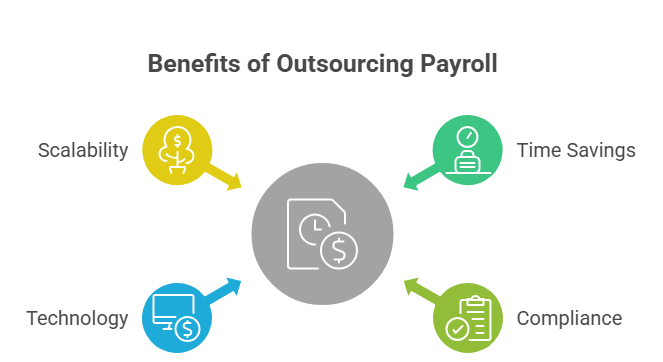
Outsourcing payroll is more than delegating a task. It’s a way to free up internal resources and improve efficiency. Here are some commonly cited benefits:
1. Save Time and Reduce Errors
Payroll involves repetitive calculations and careful record-keeping. By choosing outsourcing payroll, your team can spend less time on administrative work and more time on core business priorities, whether that’s managing employees, serving clients, or expanding your operations.
For Houston freelancers or small business owners, this may also support smoother individual tax management, complementing individual tax preparation efforts during filing season.
2. Improve Compliance and Reduce Risk
Professional payroll providers may help businesses remain compliant with federal, state, and local requirements. While this is not a guarantee against issues, it may help reduce the risk of errors that could trigger fines or penalties.
Houston businesses in particular, especially in industries common across Houston such as oil and gas services, hospitality, retail, and construction, benefit from having payroll aligned with broader compliance practices. Linking payroll with overall tax planning may provide a more organized approach to year-round financial management.
3. Access Advanced Technology
Many payroll providers offer secure platforms that handle calculations, direct deposits, and reporting in a streamlined way. This technology helps to keep sensitive data protected and allows efficient processing of employee payments.
For businesses already using cloud accounting tools, outsourced payroll often integrates smoothly, supporting bookkeeping and business tax preparation tasks.
4. Scalability for Growth
As your business grows, payroll complexity may increase. Hiring additional staff to manage payroll internally can be costly and time-consuming. Outsourced services can scale alongside your company, adjusting for new hires, seasonal fluctuations, or changes in pay structures.
For example, we worked with a Houston-based service business whose internal team spent hours each week manually processing payroll. Their internal team spent hours each week manually processing payroll. After switching to outsourced support, payroll processing became largely automated, allowing the staff to focus on client projects instead.
Why Use a Payroll Service?
Beyond convenience, a professional payroll service may help businesses:
- Maintain organized records
- Maintain timely and consistent employee payments
- Simplify year-end reporting and documentation
- Reduce administrative stress on internal teams
Whether you’re in Houston’s service industry, retail, or oil and gas sector, leveraging expertise in payroll may provide a more consistent process than DIY approaches.
Advantages of Outsourced Payroll Services. Summary
In summary, the main advantages of outsourcing payroll services include:
- Time savings for internal staff
- Enhanced calculations and tax reporting
- Reduced compliance risk
- Scalability for growing teams
- Integration with bookkeeping and accounting processes
While every business is different, many companies find these benefits valuable for maintaining smooth operations and reducing administrative distractions.
Our Client Example
We recently worked with a Houston-based home decor business that was managing payroll internally. The owner found that processing employee wages, tracking hours, and handling tax deductions manually was taking nearly five hours every other week.
After discussing their workflow, we suggested exploring outsourced payroll services. By integrating professional payroll support into their routine, the business significantly reduced the time spent on payroll tasks.
This change allowed the team to focus on customer service and store operations, while payroll calculations, tax withholding, and reporting were managed securely and efficiently.
While results vary by business, this case illustrates how outsourcing payroll may support smoother internal operations and reduce administrative stress.
How to Choose an Outsourced Payroll Provider
When evaluating providers, consider:
- Experience with your industry and business size
- Security measures for sensitive payroll data
- Integration with existing accounting systems
- Range of services offered
Houston businesses, for instance, may prioritize providers familiar with Texas employment regulations and state-specific reporting requirements.
FAQs
Is outsourcing payroll a good idea?
Outsourcing payroll may save time by reducing the complexity of manual payroll processing and administrative tracking.
How much does it cost to outsource payroll?
Costs vary based on provider and service level. Some charge per employee, others a flat monthly fee. Businesses should compare services against internal time and software expenses.
Can outsourced payroll handle compliance issues?
Yes, professional services stay up to date with regulations and filing requirements. While they cannot guarantee complete avoidance of issues, they may help reduce risk.
Will outsourcing payroll integrate with accounting software?
Yes, many providers offer integrations with popular bookkeeping tools, simplifying financial reporting and reconciling with business tax preparation or bookkeeping systems.
Making the Switch
Switching to outsourced payroll services can relieve Houston business owners of tedious administrative tasks, improve payroll consistency, and provide access to professional tools and expertise. While not a one-size-fits-all solution, many local businesses may benefit from delegating payroll to experienced providers.
At Dabney Tax & Accounting Services, we offer a range of financial services that complement outsourced payroll, from bookkeeping and payroll integration to individual and business tax support. Leveraging these services may support smoother payroll operations, more organized recordkeeping, and better allocation of internal resources.


