
When running a business in Houston, one of the most important financial tasks we often face is financial statement preparation. When done consistently, the process may help businesses better understand profitability, cash flow, and overall financial position, which is essential whether you’re managing a small service business or a growing enterprise.
In this guide, we’ll explore what a financial statement is, the key steps involved, and how businesses can make it more manageable for long-term success.
Understanding Financial Statements and Their Importance
Financial statements are structured reports that summarize the financial performance and position of a business. The main statements include:
- The Income Statement (also termed as Profit and Loss statement) shows revenue, operating costs, and net income over a period and helps identify profitability trends and areas for improvement.
- A Balance Sheet captures assets, liabilities, and equity at a specific point in time and provides insight into liquidity and capital structure.
- Cash Flow Statement tracks cash inflows and outflows from operating, investing, and financing activities and highlights overall cash availability.
- Statement of Retained Earnings explains changes in equity that result from retained profits or dividend distributions.
Consistent financial statement preparation may help keep these reports organized and aligned with underlying business transactions. Moreover, one of the surveys shows that more small businesses reported revenue declines than growth in recent years, highlighting how accurate financial insights can be essential.
Why Statement Preparation Matters for Decision-Making
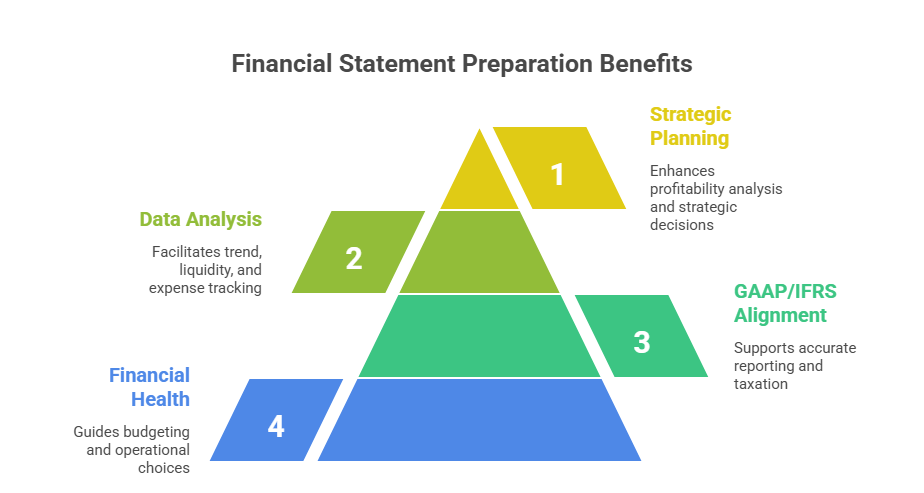
Without organized financial statements, businesses may find it harder to understand their financial position. Some key benefits include:
- Knowing your financial health helps guide budgeting, staffing, and operational choices.
- Many businesses organize their financial records using frameworks such as GAAP or IFRS when applicable.
- Trend analysis, liquidity evaluation, and expense tracking become easier with organized financial data, helping support profitability analysis and strategic planning.
For example, a Houston-based home services company noticed inconsistencies in monthly expenses during a routine review. Once they prepared a financial statement, they identified areas where spending was higher than expected, helping clarify operational choices.
In many cases, maintaining clean daily records through routine bookkeeping and payroll services may support this preparation process.
Essential Steps in Financial Statement Preparation and Account Reconciliation
Proper financial statement preparation requires a structured approach. Here’s a high-level overview:
1. Reconcile Accounts Thoroughly
Verify that all bank statements, credit accounts, and ledgers match actual transactions. This account reconciliation step helps prevent discrepancies and supports accurate financial reporting.
2. Categorize Transactions Accurately
Group income, cost of goods sold, and operating expenses into the appropriate accounts. Proper categorization is vital for clarity on profitability and overall financial position.
3. Adjust Journal Entries Appropriately
Make necessary accrual or deferral adjustments so that expenses and revenue are recorded in the correct period, helping statements reflect current business activity in a consistent manner.
4. Generate a Trial Balance for Accuracy
Compile a trial balance to verify that total debits equal total credits, serving as a checkpoint before finalizing statements.
5. Finalize Statements Systematically
Once the trial balance is verified, prepare the Balance Sheet, along with the Income Statement and Cash Flow Statement. The Income Statement’s net income often informs the Balance Sheet and Cash Flow Statement, maintaining consistency across reports.
Houston businesses frequently find that reviewing prepared statements with a focus on trends or unusual account activity enhances decision-making. Leveraging insights from financial reporting and analysis can further support understanding patterns in cash flow.
Best Practices for Houston Businesses in Financial Statement Preparation
Adhering to best practices may make financial statement preparation more effective and may help reduce the likelihood of errors:
- Consistency Across Reporting Periods: Use consistent accounting methods and reporting periods for meaningful comparisons over time.
- Regular Review and Trend Analysis: Monthly or quarterly reviews of statements may detect unusual trends or discrepancies early and support profitability analysis.
- Avoid Common Errors: Double-check data entry, verify proper transaction categorization, and reconcile bank statements to prevent inaccuracies.
Toward year-end or during tax preparation, clear statements may also allow businesses to manage adjustments and plan efficiently. Incorporating these insights with the help of a tax planning service may help Houston companies align financial reporting with broader operational needs.
How We Helped a Houston Client Streamline Their Financial Statements
One of our Houston clients, a small oil & gas contractor, had been tracking project expenses in spreadsheets. During their end-of-month review, they noticed inconsistencies that made it difficult to get a clear picture of cash flow and profitability.
We assisted them with structured financial statement preparation practices, including detailed account reconciliation, which helped organize and categorize their records accurately. After this process, the client could see a clearer view of their monthly financial position and better understand trends in revenue and expenses.
FAQs
1. What is included in financial statement preparation?
Financial statement preparation typically involves compiling balance sheets, P&L statements, cash flow statements, and statements of retained earnings.
2. How often should businesses prepare financial statements?
Many businesses review and prepare statements monthly or quarterly to maintain oversight on profitability and cash flow, though annual preparation may also satisfy reporting and tax purposes.
3. What are common challenges in financial statement preparation?
Errors often arise from miscategorized transactions, unreconciled accounts, or inconsistent accounting periods. Implementing standardized processes and reviewing transactions regularly may help reduce these risks.
4. How does financial statement preparation support decision-making?
Accurate financial statements may help businesses review trends, liquidity, and profitability when making operational or financial decisions.
Streamlining Financial Statement Preparation for Houston Businesses
By following structured processes, maintaining consistent bookkeeping practices, and periodically reviewing financial records, businesses can strengthen their financial statement preparation and support reporting that is both reliable and insightful.
Keeping your financial records accurate and organized doesn’t have to be a constant struggle. At Dabney Tax & Accounting Services, we partner with Houston businesses to simplify financial reporting. We help Houston businesses organize financial reporting so owners can focus on running their operations.