
When it comes to understanding the financials of real estate, working with a CPA who understands real estate investment may help simplify financial tracking and tax reporting. From understanding depreciation rules to managing passive activity loss limitations, these professionals often help investors identify opportunities that may support better cash flow and tax planning.
Real estate investing involves ongoing decisions that can impact taxes, financial reporting, and compliance. Working with a CPA who understands these nuances often allows investors to focus on growing their portfolios while helping keep financial records organized and aligned with reporting requirements.
Why a Real Estate-Focused CPA Matters
General accountants handle a wide range of clients, but a CPA specializing in real estate investment brings focused knowledge that can support nuanced strategies for property investors. According to IRS data, the real estate and rental sector accounted for over half of all U.S. partnerships in 2022, illustrating how pervasive real estate investment has become.
For example, consider a Houston property owner who recently purchased a mixed-use building downtown. By working with a real estate CPA, they may identify depreciation opportunities across the property’s components, fixtures, appliances, and structural improvements that could influence taxable income in ways a general accountant might overlook.
Key Strategies Used by Real Estate CPAs
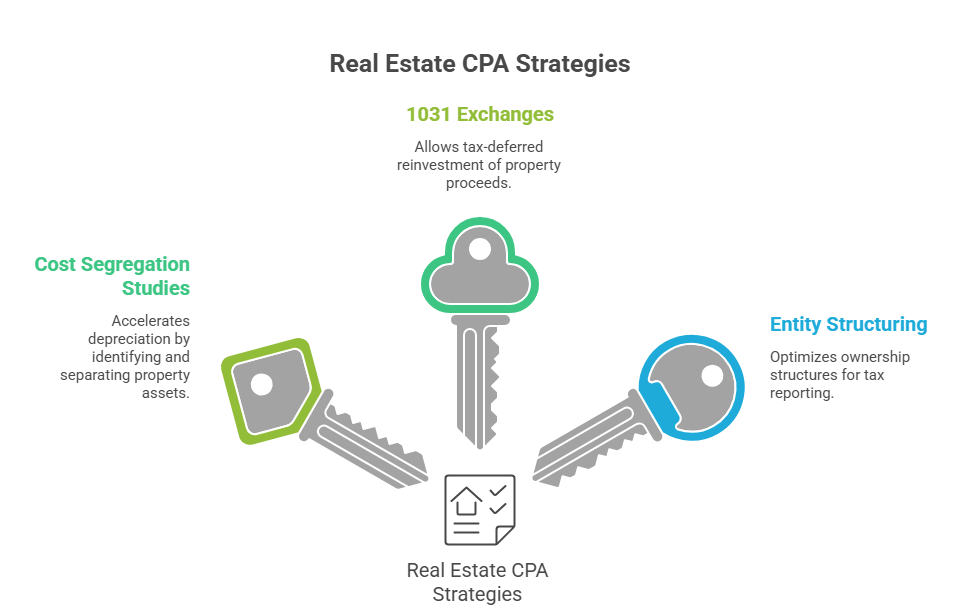
A CPA specializing in real estate often leverages multiple approaches to support investors from a tax perspective:
Cost Segregation Studies
Cost segregation studies analyze a property’s components to determine whether certain assets may qualify for shorter depreciation schedules. By identifying specific assets, such as HVAC systems or lighting, investors may be able to recognize certain depreciation deductions earlier, depending on the property and supporting analysis.
1031 Exchanges
Also known as tax-deferred exchanges, 1031 exchanges allow investors to reinvest proceeds from one property into another without immediately triggering capital gains tax. While not a guaranteed result, planning with a CPA may help investors understand how these transactions interact with tax reporting requirements.
Entity Structuring
Optimizing ownership structures, like establishing LLCs or partnerships, can influence how income and losses are reported. While we cannot give legal guidance on entity choice, a CPA specializing in real estate investment may provide insight into how different structures could affect bookkeeping, tax preparation, and reporting obligations.
Integrating Tax Preparation and Financial Analysis
Investors often benefit from combining specialized accounting support with broader financial services. For instance, using a business tax preparation service alongside real estate-focused strategies may allow a more comprehensive view of taxable income and deductions.
Similarly, financial reporting can highlight trends across multiple properties, helping investors understand cash flow patterns and potential timing for reinvestment.
Active vs. Passive Income Considerations
One of the more complex aspects of real estate taxation is differentiating active and passive income. Investors who meet certain thresholds may qualify as real estate professionals, which can influence how losses offset other income.
While qualification depends on multiple factors, a CPA specializing in real estate investment can often clarify reporting requirements, documentation, and compliance considerations for Houston-based investors managing multiple properties.
Short-Term Rentals and Emerging Opportunities
Short-term rental properties have become increasingly common in Houston’s neighborhoods near downtown and the Galleria area. Accounting for rentals with stays under seven days introduces unique considerations regarding potential deductions and tax treatment.
A CPA may help investors understand how to track income and expenses so records remain organized for tax reporting.
Local Houston Context and Considerations
Houston’s real estate market includes commercial buildings, single-family rentals, and mixed-use developments. Each type presents its own accounting challenges. For instance, oil-and-gas investors who also hold rental properties may encounter overlapping reporting requirements that a CPA specializing in real estate can help manage.
Similarly, Houston small business owners expanding into property investments often find that support from a CPA specializing in real estate investment may help reduce the likelihood of overlooked deductions or incomplete records.
Case Example of Our Client
One of our Houston clients owns a mix of residential rental properties and a small short-term rental near the Galleria area. By working closely with our team, we worked with them to track improvements separately from routine repairs and organized their bookkeeping to align with both individual and business tax preparation needs.
Through our collaboration, they were able to better monitor depreciation schedules and ensure that income from different property types was clearly documented. While results vary by client, this approach often supports more efficient tax reporting and a clearer overview of property performance.
FAQs
1. What is the role of a real estate CPA in managing rental property taxes?
A real estate CPA often helps categorize expenses, track depreciation, and identify potential deductions. While outcomes vary by property and investor situation, their guidance may support organized and accurate tax reporting.
2. Can a CPA specializing in real estate investment help with short-term rental income?
Yes, they can provide insight into tracking income and expenses, as well as highlight considerations for potential tax implications. This is especially relevant for properties with fluctuating occupancy rates or short-term leases.
3. How does cost segregation benefit real estate investors?
Cost segregation may help accelerate depreciation on property components, which could influence taxable income in earlier years. The specific benefits depend on the property type, improvements, and the investor’s broader financial picture.
4. Are 1031 exchanges complicated for small investors?
1031 exchanges involve precise timing and documentation requirements. A real estate CPA may provide guidance on how to align transactions with tax reporting expectations and assist with bookkeeping to support compliance.
Partnering with Experts to Support Your Investment Goals
For Houston investors navigating the evolving real estate landscape, a CPA specializing in real estate investment may help provide the clarity and organization needed to manage multiple properties effectively. By combining specialized accounting and business tax preparation services, investors may gain a comprehensive view of their portfolio.
Meanwhile, for structural guidance, you can contact Dabney Tax & Accounting Services. We help property investors stay organized with numbers and integrate tax preparation with broader financial oversight. Whether managing residential rentals or commercial assets, our team is committed to supporting Houston investors with guidance that aligns with their goals.