
It’s a question we hear more often than people expect: Can I file taxes with no income? Whether you’re between jobs, a student, or simply had a quiet financial year, it’s natural to wonder if filing still matters.
In many cases, filing a return may still offer certain benefits, even if you didn’t earn anything. Let’s walk through what this really means, when it applies, and why it might still make sense to file.
Do You Actually Need to File
From an IRS standpoint, filing requirements are based on income thresholds. If your income falls below certain IRS filing thresholds, you may not be required to file a federal return. That said, the question isn’t just can I file taxes with no income, but whether you should.
Even if you’re not required to file, there are situations where doing so may still be beneficial. For example, if taxes were withheld earlier in the year or if you qualify for certain refundable credits, filing could help you claim those amounts. This is where the idea of can you file taxes without working becomes relevant. Not working doesn’t necessarily mean you can’t file.
Why Filing With No Income May Still Make Sense
There are a few reasons people still choose to file.
1. Claiming Refundable Credits
Some tax credits are refundable, meaning they may provide a refund even if you owe no tax. Eligibility depends on your situation, but filing is often required to claim them.
2. Getting Back Withheld Taxes
If you had a job earlier in the year and taxes were withheld, filing may allow you to recover those amounts.
3. Creating a Financial Record
A filed return can serve as documentation of your financial activity for the year. This may be useful when applying for housing, loans, or certain programs.
4. Identity Protection
Filing a return may help reduce the risk of fraudulent filings under your name. So again, the answer to the question “Can I file taxes with no income?” is yes, and in many cases, people choose to do so for practical reasons like these.
How Do You File Taxes With No Income
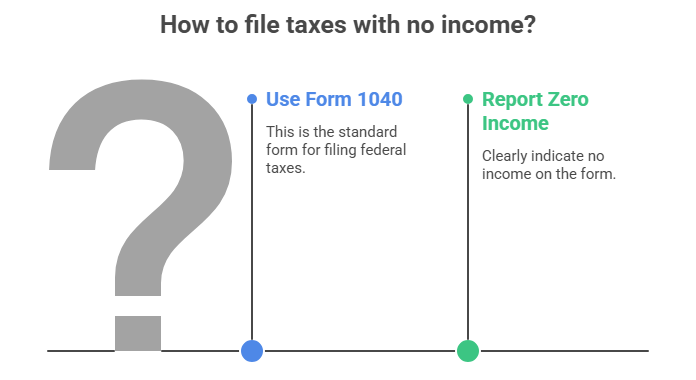
The process is generally similar to filing any other return, with a few small differences. You would typically use Form 1040 and report your income as zero.
Further, in many cases, maintaining organized records throughout the year can make this process smoother. For example, maintaining organized financial documentation may help support consistency in how information is reported over time.
A Practical Example From a Houston Client
A self-employed designer experienced a slow year due to paused client work. By the end of the year, their income was effectively zero. They asked us: “Can I file taxes with no income, or is there no point?”
From a general standpoint, they weren’t required to file. However, they had a small amount of prior withholding and wanted to keep their records consistent year over year. They chose to file, not out of obligation, but because it aligned with their documentation needs.
This kind of situation isn’t unusual in Texas, especially among freelancers, contractors, and service-based businesses, where income can fluctuate from year to year.
What If You’re Self-Employed
Self-employment can add another layer to the discussion. If your net earnings exceed certain thresholds, filing may still be required. However, if your net income is zero, the requirement may not apply in the same way.
Still, the question “Can I file taxes with no income?” often comes up for self-employed individuals who want to maintain continuity in their records.
From a broader perspective, consistent recordkeeping and forward-looking planning can be helpful. Approaches like tax planning are often used by business owners to stay organized across both high-income and low-income years.
Common Misunderstandings
Let’s clear up a few common points of confusion.
“If I didn’t earn anything, I can’t file.”
No. The question if you have no income, can you file taxes has a straightforward answer: yes, you can.
“Filing with no income is pointless.”
Not always. Depending on your situation, there may still be reasons to file.
“It’s complicated to file with zero income.”
In many cases, it’s simpler than a typical return, as long as the information reported is properly maintained.
Is It Hard to File Taxes With No Income
Generally, it’s not particularly difficult. Some systems may reject a zero-income return, which is why some e-filing systems require a small nominal amount to process a return, depending on the platform used.
If you prefer additional clarity, working through a structured process, such as an individual tax preparation process, may help keep everything aligned and consistent.
Are There Any Downsides
Filing with no income doesn’t typically carry major drawbacks, but it may involve time and administrative effort.
If there’s no clear benefit, such as a refund, credit eligibility, or documentation need, some individuals may choose not to file.
When It May Be Worth Taking a Closer Look
If you’re still wondering, can I file taxes with no income, here are a few situations where it may be worth exploring further:
- You had taxes withheld earlier in the year
- You may qualify for refundable credits
- You want to maintain consistent financial records
- You’re applying for housing or financial assistance
- You prefer to keep your filings up to date
In these cases, filing may support better organization and documentation, even if it’s not required.
FAQs
1. Can I file taxes with no income if I didn’t work at all?
Yes, it applies even if you didn’t work. Filing is still possible, depending on your situation.
2. Will the IRS reject a return with zero income?
Some e-filing systems may not accept a zero-income return. A small nominal amount is sometimes used to allow processing, depending on the platform.
3. Can filing with no income help me get a refund?
It may, especially if you had prior withholdings or qualify for refundable credits. Eligibility can vary.
4. Do I need professional help to file with no income?
Not always. However, some individuals prefer guidance to ensure everything is reported clearly and consistently.
Final Thoughts
So, circling back to the question, can I file taxes with no income? Yes, you can. And in many situations, it may be worth considering, even if it’s not required. Across Houston and broader Texas, we often see individuals with fluctuating income, and in those cases, filing can sometimes support better recordkeeping and continuity.
If you’re thinking through your next step, it may simply come down to understanding your situation clearly and keeping your records consistent. That’s often where working with our team at Dabney Tax & Accounting Services may help bring everything into focus.