

Tax planning Houston is something many business owners and individuals put off until tax season is already underway, and by that point, many of the most useful planning conversations are no longer possible. At Dabney Tax & Accounting Services, we work with clients across the Houston area throughout the year to help them think through their tax position before deadlines arrive rather than after.
This blog walks through what tax planning generally involves, why timing matters, and what Houston business owners and individuals can do to approach their tax obligations more thoughtfully.
Tax Planning vs. Tax Preparation: An Important Distinction
These two terms often get used interchangeably, but they refer to different things. Tax preparation is the process of compiling records and filing a return for a year that has already passed. Tax planning is a forward-looking conversation that happens throughout the year, focused on how current and upcoming financial decisions may affect your overall tax position.
For business owners in Houston’s fast-moving industries, from energy services firms in the Energy Corridor to healthcare practices near the Texas Medical Center, the difference between reactive and proactive tax management can affect how much time remains to review available options. Many taxpayers discover too late that withholding or estimated payments were not reviewed during the year.
Working with a qualified Houston CPA who understands both federal tax law and Texas-specific obligations may help individuals and business owners feel more informed about tax planning in Houston and their position throughout the year.
Why Year-Round Engagement Tends to Work Better
One of the more common patterns we see at Dabney Tax & Accounting Services is clients coming to us in March or April, hoping to address tax-related concerns that would have been much easier to handle in October or November. Year-round tax planning in Houston works better for a simple reason: some decisions only may affect the available tax treatment if they are made before the year closes.
Timing-related considerations that often come up in planning conversations include reviewing estimated quarterly tax payments, discussing large purchases or expenses before year-end, and understanding how changes in income throughout the year may affect overall obligations. These are conversations that benefit from happening with enough lead time to act on them.
For individuals looking into proactive individual tax preparation and planning support, starting that conversation before the fourth quarter of the year tends to allow more room for meaningful input.
Common Areas Reviewed During Tax Planning
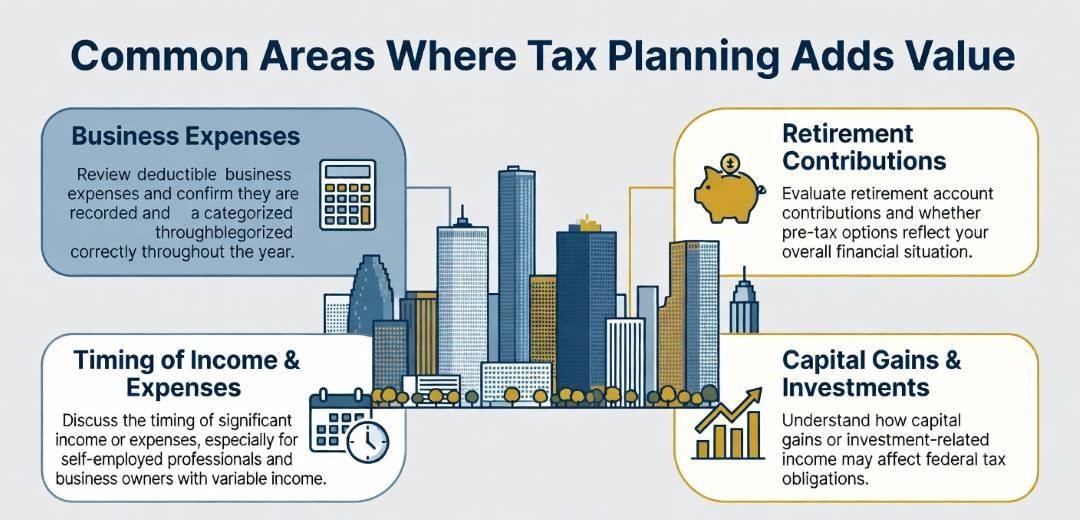
Tax planning in Houston typically involves reviewing several areas of a client’s financial picture to identify where timing, categorization, or structuring decisions may have tax implications. A few of the areas that come up most regularly in our client conversations include
- Reviewing deductible business expenses and confirming they are being recorded and categorized correctly throughout the year
- Evaluating retirement account contributions and whether pre-tax options are being used in a way that reflects the client’s overall financial situation
- Discussing the timing of significant income or expenses, particularly for self-employed professionals and business owners with variable income patterns
- Understanding how capital gains or investment-related income may affect federal tax obligations for the year
These aren’t one-size-fits-all discussions. A freelance consultant in Midtown has a different set of considerations than a construction company owner operating out of Katy, and our planning conversations are shaped by each client’s specific circumstances.
How Bookkeeping Connects to Effective Tax Planning
Clean financial records are the foundation of useful tax planning. When books are disorganized or months behind, it becomes difficult to have an informed planning conversation because the numbers needed to support that discussion aren’t reliable or current.
At Dabney Tax & Accounting Services Houston, we often work with clients on both bookkeeping and tax planning together because the two functions are closely connected. Businesses that maintain well-reconciled monthly records are generally better positioned to have timely, relevant conversations about their tax position throughout the year.
Businesses looking for a more connected approach to bookkeeping and payroll services alongside tax planning support may find that having both functions handled by one team simplifies the overall experience considerably.
FAQs
When is the best time to start thinking about tax planning for the year?
From a practical standpoint, the earlier in the year the better. Many planning-related decisions, such as adjusting estimated payments or timing significant expenses, are only useful if there is enough time left in the year to act on them. Many CPAs recommend revisiting your tax position at least once mid-year and again in the fall.
Is tax planning only useful for high-income individuals or large businesses?
Not necessarily. While the complexity of planning conversations tends to increase with income and business size, individuals and small business owners at various income levels can benefit from reviewing their estimated payments, understanding deductible expenses, and timing financial decisions thoughtfully. Even relatively straightforward tax situations can benefit from a professional review.
How does tax planning differ for self-employed professionals compared to salaried employees?
Self-employed professionals generally have more flexibility in how and when income and expenses are recorded, which creates more opportunities for timing-related planning conversations. They are also responsible for managing their own estimated quarterly payments, which makes regular check-ins with a tax professional particularly useful throughout the year.
Can tax planning help if I have already had a high-income year?
In many cases, there are still options worth discussing even after a high-income year has largely played out. Retirement account contributions, timing of year-end expenses, and other considerations may still be relevant depending on the specific circumstances. A CPA can help you understand what options may still be available before the year closes.
A More Informed Approach Starts Before Tax Season
Tax planning in Houston doesn’t have to feel like a last-minute scramble. When approached as a year-round conversation rather than a once-a-year event, it tends to feel more manageable and more useful for the business owners and individuals who commit to it.
At Dabney Tax & Accounting Services, we work with Houston-area clients across industries to support more informed, proactive conversations about their tax position throughout the year. Reaching out before the year-end rush tends to allow more time for the kinds of discussions that may support a more organized filing season.


