
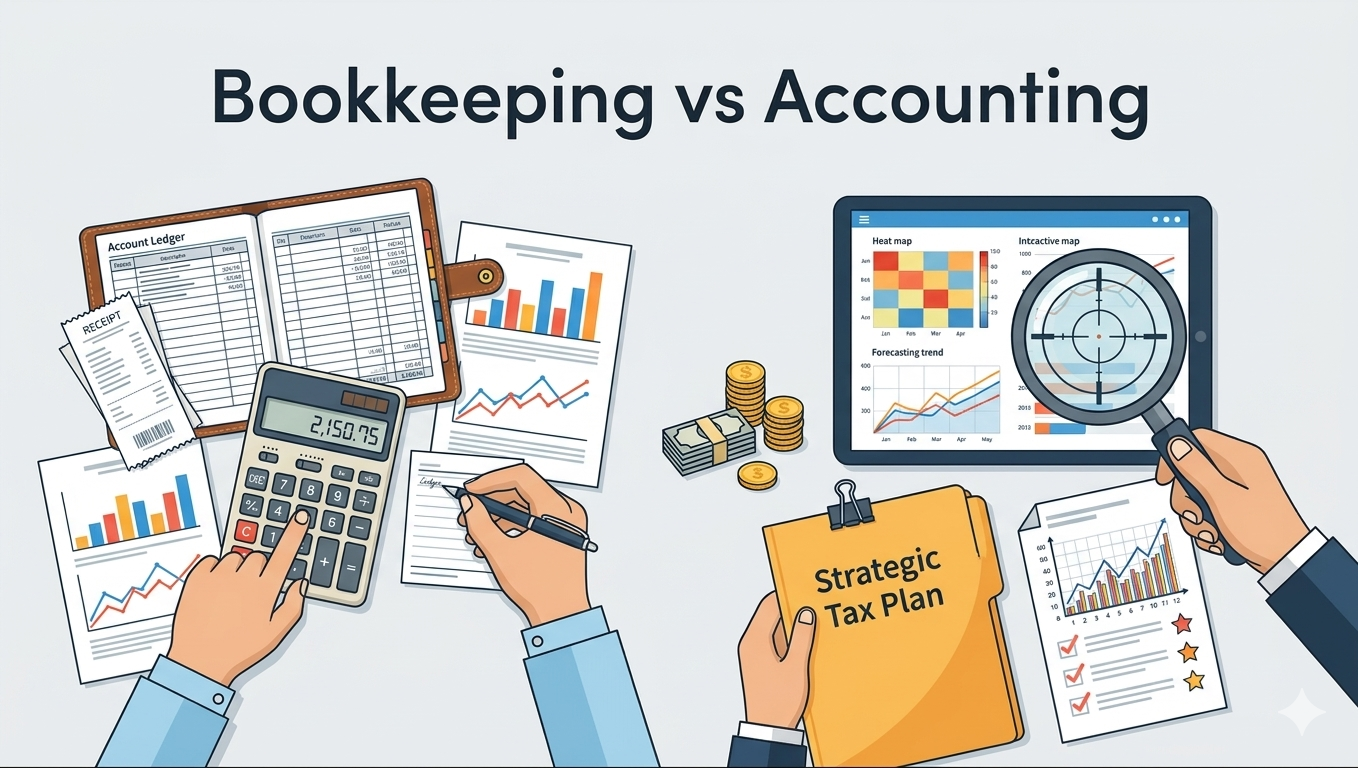
When business owners start organizing their finances, one question almost always comes up: accounting vs bookkeeping. We often get asked what the difference is and which one matters more at different stages of a growing business.
It’s a fair question. At first glance, the two terms seem interchangeable. But in practice, they play different roles in how financial information is recorded, reviewed, and used. Let’s break down how these roles differ and how businesses often use them.
Understanding the Role of Bookkeeping
Bookkeeping focuses on the day-to-day recording of financial transactions. Think of it as the foundation of financial organization. Federal data shows small businesses employ millions of workers nationwide, which highlights how important organized financial systems become as companies grow.
As these businesses grow, financial records often become more complex, which is where bookkeeping and accounting roles begin to complement each other.
Typical bookkeeping activities often include:
- Recording income and expenses
- Categorizing transactions
- Reconciling bank and credit card accounts
- Managing invoices and payments
- Recording payroll-related transactions
- Maintaining organized financial records
For many small businesses in Houston, bookkeeping starts fairly simply. A restaurant owner, for example, may track sales and supplier payments weekly. A contractor might record project expenses and payments from clients.
Over time, though, transaction volume tends to grow. That’s when consistent bookkeeping becomes more valuable.
Businesses that find themselves spending too much time on financial entries often explore professional help, such as bookkeeping and payroll services, which may help maintain organized records throughout the year. Clean financial data often makes later reporting and tax preparation smoother.
Understanding the Role of Accounting
Accounting builds on the financial information created through bookkeeping. Instead of focusing on recording transactions, accounting typically looks at the bigger picture.
Accounting activities may include:
- Reviewing financial statements
- Preparing year-end reports
- Interpreting financial trends
- Supporting tax preparation
- Providing financial summaries for business owners
While bookkeeping organizes the data, accounting often analyzes that information. Some businesses also explore services like tax planning when they want a broader understanding of how financial activity may relate to upcoming tax obligations. These discussions typically remain educational and high-level rather than prescriptive.
Accounting vs Bookkeeping: Key Differences
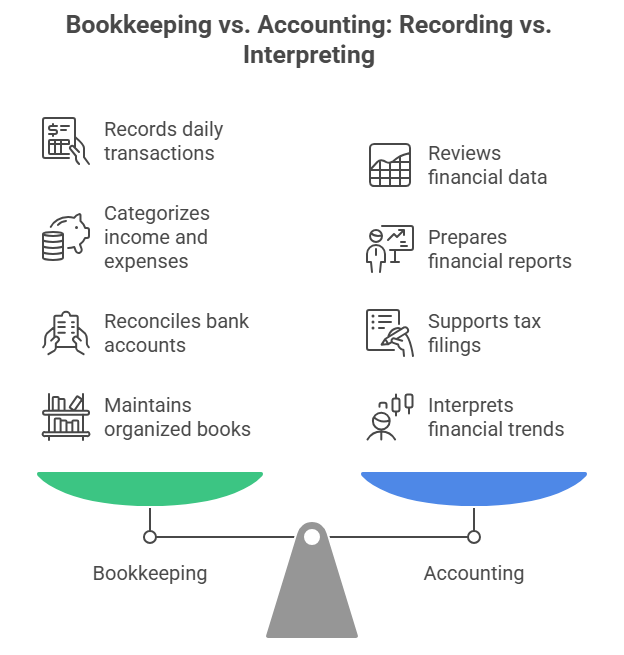
So, where exactly does accounting vs bookkeeping become clear? The distinction usually comes down to recording vs interpreting financial information.
Bookkeeping generally focuses on maintaining organized transaction records. Accounting, on the other hand, often reviews those records and turns them into financial reports or tax documentation. Another way to think about it:
| Bookkeeping | Accounting |
| Records daily transactions | Reviews financial data |
| Categorizes income and expenses | Prepares financial reports |
| Reconciles bank accounts | Supports tax filings |
| Maintains organized books | Interprets financial trends |
Many people searching online ask, “What is the difference between bookkeeping and accounting?”, and the simplest answer is that bookkeeping creates the financial record, while accounting uses that record for reporting and analysis.
You may also hear the phrase bookkeeping vs accounting, which reflects the same comparison: two connected roles that support different parts of the financial process.
When Businesses Typically Start With Bookkeeping
In the early stages, a company’s financial needs are often centered around staying organized. Owners want to track income, record expenses, and keep documentation ready for tax time. Common situations where bookkeeping becomes useful include:
- Growing numbers of monthly transactions
- Difficulty keeping financial records organized
- Time constraints for business owners handling their own books
- Preparation for annual tax filings
When Accounting Becomes More Relevant
As businesses grow, financial questions often expand beyond basic transaction tracking. Owners may want to review year-end financial reports, understand how expenses changed over time, or prepare formal tax filings. That’s where accounting work often becomes more involved.
Accounting activities frequently connect with tax preparation as well. Businesses that are preparing annual returns may explore services like business tax preparation to organize financial information for filing purposes.
From a compliance perspective, having well-maintained books may support smoother reporting. Accounting then uses that information to produce financial statements and tax documentation.
A Houston Business Example
To illustrate how accounting vs bookkeeping often works in real life, consider an example based on a Houston service business we worked with.
A small HVAC service company in Houston began with just two technicians and a few dozen clients. In the first year, the owner handled invoices and expenses personally using simple accounting software.
As the business grew, the company added more technicians and started handling dozens of transactions each week. At that point, regular bookkeeping helped organize payments, supplier expenses, and payroll records. Later, when preparing year-end financial reports and tax filings, accounting work became part of the process as well.
This kind of progression is common among Texas service businesses. Bookkeeping often supports the daily recordkeeping, while accounting helps review that information during reporting periods.
Do Businesses Usually Need Both?
In many cases, yes. The discussion around accounting vs bookkeeping isn’t really about choosing one over the other. Instead, they typically support different stages of financial management as a business grows.
Bookkeeping keeps records organized on an ongoing basis. Accounting often reviews those records periodically for reporting or tax documentation.
Another common question people ask is, “Is bookkeeping the same as accounting?” While the terms are related, they represent separate functions that work together. Many firms structure their financial workflow this way:
- Bookkeeping maintains transaction records throughout the year.
- Accounting reviews those records when preparing reports or tax filings.
This combination may create a clearer financial picture for business owners.
FAQs
What is the main difference between bookkeeping and accounting?
Bookkeeping generally involves recording daily financial transactions, while accounting focuses on reviewing and interpreting that financial information through reports and tax filings.
Can a small business operate with bookkeeping only?
Yes, some small businesses begin with bookkeeping alone, especially during the early stages. As financial activity grows, accounting services may also become part of the process.
Is bookkeeping the same as accounting?
No, bookkeeping focuses on recording financial data, while accounting typically reviews that data for reporting, financial summaries, and tax preparation.
Do most businesses eventually need both bookkeeping and accounting?
In many cases, yes. Bookkeeping maintains organized records throughout the year, and accounting uses those records when financial reporting or tax preparation takes place.
Conclusion
Understanding accounting vs bookkeeping can help clarify how financial information moves through a business. Bookkeeping generally focuses on recording day-to-day transactions, while accounting reviews that information for reporting and tax preparation purposes.
If you’re exploring how these services might fit your business operations, you can learn more through Dabney Tax & Accounting Services, where bookkeeping, accounting, and tax-related support are available for Houston business owners.


