
For many Texas small business owners, the accounting function can feel like a “black box.” Invoices, receipts, and payroll data go in, but the financial reports that come out may be late, unclear, or incomplete. When owners can’t rely on their numbers, it becomes harder to make confident decisions about pricing, hiring, cash flow, or growth.
This challenge often leads business owners to ask: why outsource accounting services? In our Houston CPA practice, we see that outsourcing doesn’t just improve bookkeeping consistency. It can improve a business owner’s financial decision-making process.
This guide explains why outsourcing Houston accounting services can provide clearer data, clearer processes, more consistent recordkeeping, and access to CPA oversight when needed.
What are the Limits of DIY and In-House Accounting
In the early stages, most founders handle the books themselves to save money. As the business grows, they might hire a part-time bookkeeper. While these are logical steps, both models often create a “black box” where the owner may lack clear financial visibility.
1. When Founders Handle the Books Themselves
DIY bookkeeping may work early on, but it often becomes unsustainable as the business grows. Owners split time between running operations and managing financial tasks, which can result in:
- Incomplete or inconsistent records
- Delayed reporting
- Limited insight beyond basic transaction history
This creates uncertainty when tracking cash flow, preparing for taxes, or evaluating profitability.
2. The Limitations of Hiring One Internal Bookkeeper
A single bookkeeper can assist with recording transactions, but most do not provide:
- Deeper financial analysis
- Forward-looking cash flow review
- Tax-related oversight
This means the owner receives reports but may still lack clear direction for future decisions.
Why Outsource Accounting Services Instead of Just Hiring a Bookkeeper?
Outsourcing gives you access to a complete accounting team, without hiring each role individually. Instead of relying on one employee, you get structured support at multiple levels:
- Bookkeeper: Daily transaction processing and reconciliations
- Controller: Oversight, accuracy checks, and month-end close
- CPA / Advisor: High-level tax guidance, budgeting support, and general planning insight
This tiered structure provides expertise that is typically too expensive to build in-house for many small and mid-sized businesses.
The Strategic Benefits of Outsourced Accounting
The benefits of outsourced accounting services Houston are about gaining new capabilities, not just cutting costs. It helps create a financial system that supports real decision-making.
Real-Time and Reliable Financial Reporting
Professional accounting teams use modern software to close books faster and more consistently. Instead of waiting weeks for financial reports, you often receive timely statements early in the month. This helps you:
- Identify operational issues quickly
- Track profitability efficiently
- Adjust strategies while trends are still developing
Access to a Multi-Layered Accounting Team
With outsourced support, the quality and consistency of financial operations improves through built-in oversight:
- Bookkeepers enter and categorize data
- Controllers review for consistency and completeness
- CPAs provide strategic insight
This structure may help reduce errors, improve consistency, and highlight potential areas for financial review.
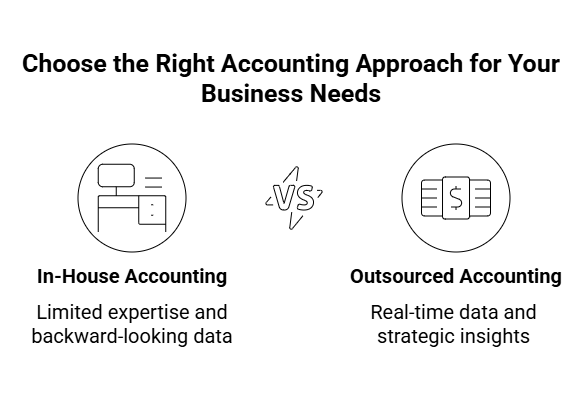
Side-by-Side Comparison of In-House vs. Outsourced Accounting
| Feature | In-House | Outsourced |
| Data Timeliness | Reports may be delayed | Faster closes and timely reporting |
| Expertise | Limited to one hire | Access to full accounting team |
| Strategic Value | Mostly historical data | Future-oriented financial clarity |
| Owner Focus | Managing tasks | High-level decision-making |
Why Houston Businesses Choose to Outsource Accounting Services
A recent example from our CPA practice illustrates this shift. We worked with a logistics company whose owner relied heavily on instinct because his financial reports were late and unreliable. His part-time bookkeeper was overwhelmed, and the business lacked a structured accounting process.
After outsourcing:
- We cleaned historical data
- Implemented a timely month-end close
- Provided service-line profitability reports
- Created reliable financial dashboards
With clearer data, he made targeted decisions, including adjusting pricing and renegotiating certain contracts, which helped the owner make clearer decisions that contributed to improved financial performance.
This type of clarity is one of the primary reasons many Houston businesses explore why outsource accounting services as part of their growth strategy.
So, Why Outsource Accounting Services?
For most business owners, the core reason is simple: outsourcing provides reliable financial information and access to specialized expertise. This helps turn messy or delayed records into a practical decision-making tool. With clearer financial visibility, owners can understand trends, identify risks, and plan more strategically.
Just as importantly, outsourcing frees your time so you can focus on operations, hiring, customer service, and business development, instead of managing spreadsheets or troubleshooting accounting issues.
If you’re ready to gain better visibility into your business finances, the CPA-led team at Dabney Tax & Accounting Services is here to help. We provide structured, consistent, and compliance-focused accounting oversight for Texas businesses.
Frequently Asked Questions
1. What are the benefits of outsourcing your accounting services?
Outsourcing provides access to an entire accounting team, reduces labor costs, may improve reporting consistency, and frees owners to focus on growth. It also strengthens oversight through controller and CPA review.
2. Should I outsource accounting for my startup?
Outsourcing can be helpful because of consistent reporting, clean books, and scalable systems, without the fixed cost of a full-time hire.
3. Why are accounting jobs being outsourced?
Due to technology and cloud-based tools, many routine accounting tasks can be completed more efficiently by specialized firms. Outsourcing helps reduce costs while improving consistency in records.
4. How much does it cost to outsource an accountant?
The cost depends on the scope of work. Basic outsourced bookkeeping for a small business might be a few hundred dollars a month. A full-service package that includes controller oversight and strategic financial management for a larger business will cost more, but it is still lower than the cost of hiring a CFO or a full-time controller.